
Sagittarius is a constellation that offers a wealth of celestial treasures for astronomers and stargazers alike. From its brightest stars to its rich array of deep-sky objects, Sagittarius is a window into the wonders of the universe. This article explores the notable stars and deep-sky phenomena that make Sagittarius a focal point for astronomical observation.
Notable Stars in Sagittarius
The brightest star in Sagittarius is Epsilon Sagittarii, also known as Kaus Australis, which
shines with a magnitude of 1.85. Despite its "alpha" designation, Alpha Sagittarii, or Rukbat, is not the brightest star, with a magnitude of 3.96. Another prominent star is Sigma Sagittarii, or Nunki, which is the second-brightest star in the constellation and is notable for its historical significance as one of the oldest star names in use.
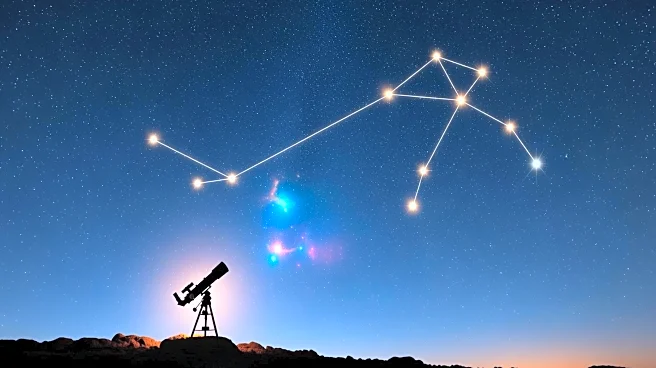
Zeta Sagittarii, or Ascella, is a double star system with components of magnitudes 3.3 and 3.5. Delta Sagittarii, known as Kaus Media, is another key star, forming part of the Teapot asterism. These stars, along with others, create the distinctive shape of Sagittarius, making it a recognizable feature in the night sky.
Deep-Sky Objects in Sagittarius
Sagittarius is home to a rich collection of deep-sky objects, thanks to its position near the center of the Milky Way. The constellation contains several well-known nebulae, including the Lagoon Nebula (Messier 8) and the Trifid Nebula (Messier 20). These nebulae are popular targets for both amateur and professional astronomers, offering stunning views of star formation and cosmic clouds.
In addition to nebulae, Sagittarius hosts a number of star clusters. The Sagittarius Star Cloud is a particularly dense area of stars, visible under dark skies. The constellation also contains the first globular cluster discovered outside the Milky Way, Messier 54, highlighting its importance in the study of our galaxy and beyond.
Observing Sagittarius
For those interested in observing Sagittarius, the constellation is best viewed during the summer months in the northern hemisphere. Its position near the Milky Way's center makes it a prime location for observing the dense star fields and nebulae that populate this region of the sky.
Whether viewed through binoculars or a telescope, Sagittarius offers a glimpse into the heart of our galaxy. Its stars and deep-sky objects provide a rich tapestry of celestial wonders, inviting exploration and discovery. For astronomers and stargazers, Sagittarius is a gateway to the mysteries of the universe, offering endless opportunities for observation and study.