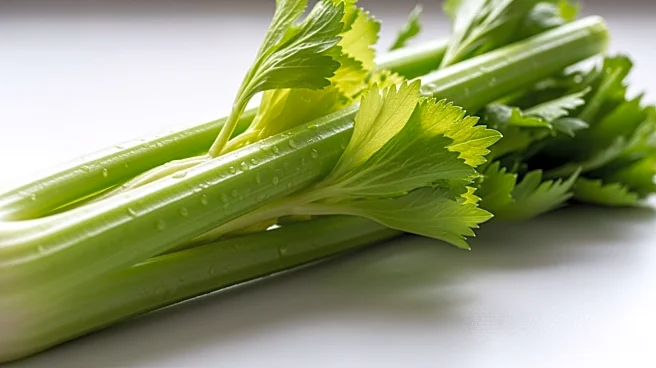




Celery, scientifically known as Apium graveolens, is a fascinating plant with distinct botanical characteristics. Belonging to the Apiaceae family, celery is cultivated for its edible stalks, leaves, and hypocotyl. This article delves into the botanical aspects of celery, examining its physical features and cultivation methods.
Botanical Characteristics of Celery
Celery is characterized by its long, ribbed stalks, pinnate leaves, and small white flowers arranged in umbels. The leaves are
pinnate to bipinnate with rhombic leaflets, measuring 3–6 centimeters long and 2–4 centimeters broad. The flowers are creamy-white, 2–3 millimeters in diameter, and are produced in dense compound umbels.
The seeds of celery are broad ovoid to globose, 1.5–2 millimeters long and wide. Modern cultivars have been selected for either solid petioles, leaf stalks, or a large hypocotyl. A celery stalk readily separates into "strings," which are bundles of angular collenchyma cells exterior to the vascular bundles.
Cultivation Methods and Varieties
Celery plants are raised from seed, sown either in a hot bed or in the open garden according to the season. After one or two thinnings and transplantings, they are planted out in deep trenches for convenience of blanching, which is achieved by earthing up to exclude light from the stems. Development of self-blanching varieties of celery, which do not need to be earthed up, dominate both the commercial and amateur market.
In North America, commercial production of celery is dominated by the cultivar called 'Pascal' celery. Gardeners can grow a range of cultivars, many of which differ from the wild species, mainly in having stouter leaf stems. The stalks grow in tight, straight, parallel bunches and are typically marketed fresh that way.
Harvesting and Storage Techniques
Harvesting occurs when the average size of celery in a field is marketable; due to extremely uniform crop growth, fields are harvested only once. The petioles and leaves are removed and harvested; celery is packed by size and quality, determined by color, shape, straightness, and thickness of petiole, stalk, and midrib length.
Under optimal conditions, celery can be stored for up to seven weeks from 0–2 °C. Inner stalks may continue growing if kept at temperatures above 0 °C. Shelf life can be extended by packaging celery in anti-fogging, micro-perforated shrink wrap.
Celery's botanical features and cultivation methods highlight its complexity and the care required to produce this versatile vegetable.