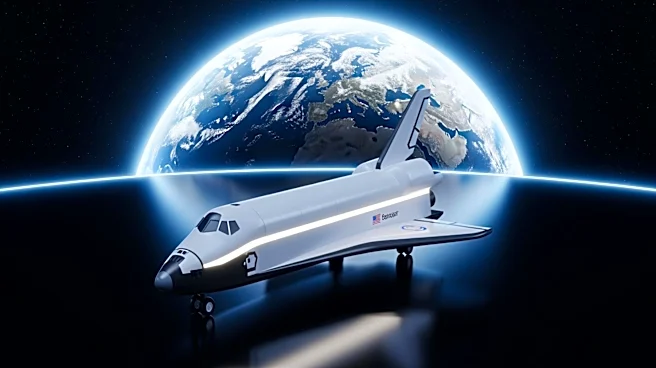







The STS-31 mission stands out as a significant milestone in NASA's Space Shuttle program. Launched on April 24, 1990, aboard the Space Shuttle Discovery, this mission was the 35th in the program and marked the deployment of the Hubble Space Telescope. The mission's success demonstrated the capabilities of the Space Shuttle and its role in advancing scientific exploration. This article explores the mission's impact on the Space Shuttle program and its legacy.
The Space Shuttle Program
NASA's Space Shuttle program was designed to provide reusable spacecraft for various missions, including satellite deployment, scientific research, and international collaboration. STS-31 was the tenth flight of the Space Shuttle Discovery, showcasing the shuttle's versatility and reliability.
The mission was initially planned for August 1986 but was delayed due to the Challenger disaster. The crew consisted of five astronauts, including Loren J. Shriver as commander and Charles F. Bolden as pilot. The successful launch from Kennedy Space Center marked a return to confidence in the shuttle program, with Discovery and Columbia simultaneously on the launch pads.
Achievements and Challenges
STS-31 achieved a record altitude for a Shuttle orbiter, reaching an apogee of 621 km. This allowed the crew to capture unique images of Earth's geographic features, contributing to the IMAX film "Destiny in Space." The mission also included various scientific experiments, such as a biomedical technology study and advanced materials research.
The deployment of the Hubble Space Telescope was a joint effort between NASA and the European Space Agency. Despite challenges with the telescope's solar arrays, the mission was successful, avoiding the need for a contingency spacewalk. The telescope's deployment marked a new era in astronomical observation, providing unprecedented clarity and detail.
Legacy and Impact
The STS-31 mission demonstrated the potential of the Space Shuttle program to support complex scientific endeavors. The successful deployment of Hubble has led to numerous discoveries and advancements in our understanding of the universe. The mission's achievements reinforced the importance of international collaboration in space exploration.
Discovery's landing at Edwards Air Force Base on April 29, 1990, marked the first use of carbon brakes on a shuttle. The mission's success paved the way for future servicing missions to Hubble, ensuring its continued operation and contribution to science. STS-31 remains a testament to the capabilities of the Space Shuttle program and its role in advancing human knowledge.