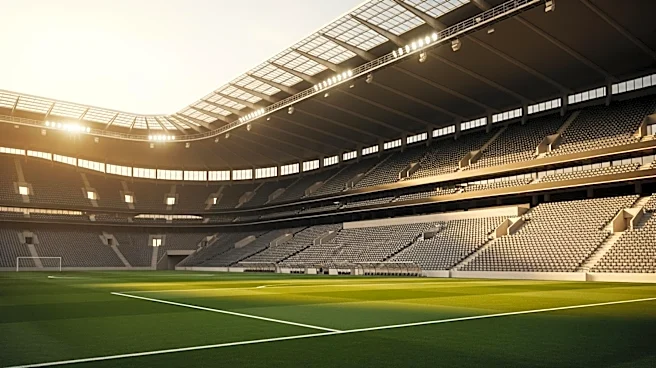






The RheinEnergieStadion, located in Cologne, Germany, is a football stadium with a rich history and significant cultural impact. Originally known as the Müngersdorfer Stadion, it has been a central hub for sports and events in the region. This article explores the historical development of the stadium, its role in major football tournaments, and its evolution over the years.
The Origins and Early Years
The RheinEnergieStadion's history dates back to the aftermath of World War
I. Under the Treaty of Versailles, Cologne's fortifications were removed, paving the way for new construction projects. The Müngersdorfer Stadion was built on the site of previous stadiums, creating 15,000 jobs and boosting the local economy. The stadium quickly became a prominent venue for domestic sports, hosting major football matches and attracting large crowds.
The first international match at the stadium took place on November 20, 1927, when Germany played against the Netherlands, resulting in a 2-2 draw. Over the years, the stadium hosted numerous matches, including the first post-war game between 1. FC Nürnberg and 1. FC Kaiserslautern, which drew a crowd of 75,000. The stadium also became known for track meets, although participation was restricted in 1933.
Renovations and Modernization
The stadium underwent significant renovations in two phases: from 1972 to 1975 and from 2002 to 2004. The first renovation aimed to prepare Cologne as a host city for the 1974 World Cup. However, financial constraints led to a scaled-down version of the stadium, inaugurated in 1975 with a capacity of 61,000 seats. This configuration allowed the stadium to host UEFA Euro 1988.
The second renovation was driven by the prospect of hosting the World Cup again in Germany. Completed in 2003, the renovation removed track-and-field facilities, bringing spectators closer to the pitch. The stadium's capacity was adjusted to accommodate 50,000 people during club matches and 45,965 for international games.
Hosting Major Tournaments
RheinEnergieStadion has been a venue for several major football tournaments. It was one of five stadiums to host both the 2005 FIFA Confederations Cup and the 2006 FIFA World Cup. During the World Cup, the stadium was temporarily renamed FIFA World Cup Stadium Cologne due to sponsorship contracts.
In addition to these tournaments, the stadium hosted the 2020 UEFA Europa League final behind closed doors due to the COVID-19 pandemic. It is also set to be one of the venues for UEFA Euro 2024, further cementing its status as a key location for international football events.