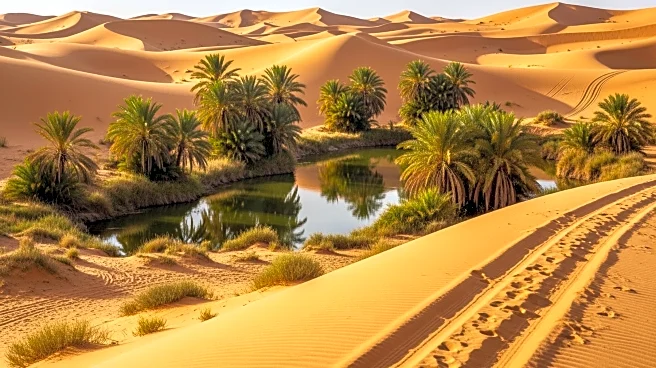




Oases have long been vital to the survival and prosperity of civilizations in desert regions. These fertile spots in otherwise arid landscapes provide essential resources such as water and vegetation, making them crucial for trade and transportation. Historically, oases have served as rest stops and supply points for caravans traversing vast desert expanses. This article explores the historical significance of oases in facilitating trade and transportation,
highlighting their strategic importance.
Historical Trade Routes
Throughout history, oases have been integral to the development of trade routes across desert regions. The presence of water and vegetation made them natural stopping points for caravans, allowing traders to replenish their supplies and rest before continuing their journeys. One notable example is the Darb El Arba'in, a trade route that connected the Al-Fashir area of Sudan to Asyut in Egypt. This route, which passed through the Kharga Oasis, was used for the transport and trade of goods such as gold, ivory, spices, and wheat.
The strategic location of oases along these routes often meant that control over an oasis equated to control over trade in the region. This was the case for the oases of Awjila, Ghadames, and Kufra in modern-day Libya, which were vital to both north-south and east-west trade in the Sahara Desert. The Silk Road, another famous trade route, relied on oasis communities such as Turpan in China and Samarkand in Uzbekistan to sustain its long-distance trade.
Military and Political Significance
In addition to their economic importance, oases have also held military and political significance. Control over an oasis often meant control over the surrounding region, as it provided a strategic advantage in terms of resources and logistics. The Romans, for example, built a chain of fortresses along the Darb El Arba'in route to protect their interests and maintain control over the region.
The presence of fortifications and settlements around oases highlights their role as centers of power and influence. These fortified oases served as bases for military operations and as hubs for political administration, further emphasizing their importance in the broader context of regional control and governance.
Modern Implications
Today, while the role of oases in trade and transportation has diminished with the advent of modern infrastructure, they continue to hold cultural and historical significance. Many oases have become tourist attractions, drawing visitors interested in their natural beauty and historical legacy. The preservation of these sites is crucial for understanding the historical dynamics of trade and transportation in desert regions.
In conclusion, oases have played a pivotal role in shaping trade and transportation routes throughout history. Their strategic importance as sources of water and sustenance made them essential for the movement of goods and people across vast desert landscapes. As we continue to explore and preserve these unique environments, we gain valuable insights into the historical interactions between human societies and their natural surroundings.