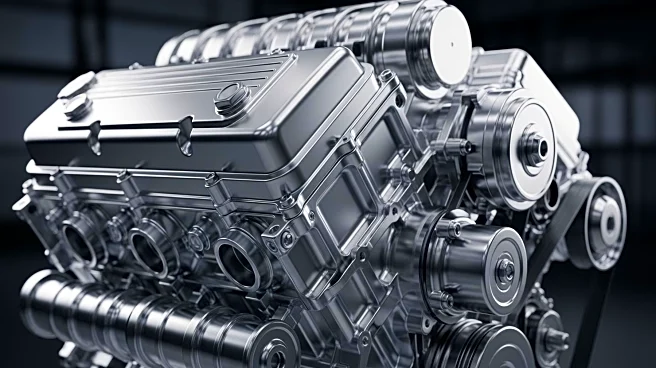




Ford's Coyote engine stands as a testament to the company's engineering prowess, showcasing a blend of innovation and performance. Introduced in 2010, this 5.0-liter V8 engine has been at the forefront of Ford's lineup, offering cutting-edge technology and impressive capabilities. The Coyote engine's design and engineering have set new standards in the automotive industry.
Innovative Design Features
The Coyote engine was designed with a focus on maximizing power and efficiency.
One of its key features is the Twin Independent Variable Cam Timing (Ti-VCT) system, which allows for precise control of intake and exhaust cam timing. This technology enables the engine to optimize power output, fuel economy, and emissions, making it a versatile choice for various applications.
Ford's engineers incorporated cam-torque-actuated (CTA) technology into the Coyote engine, further enhancing its performance capabilities. This system allows the powertrain control module to adjust cam timing independently, providing improved responsiveness and efficiency. The engine's compression ratio of 11.0:1 and port fuel injection system enable it to run on 87 octane gasoline, showcasing its adaptability.
Engineering Advancements
The Coyote engine features all-new 4-valve DOHC cylinder heads, which improve intake port geometry and outflow capabilities. This design results in an intake port that surpasses the Ford GT's by 4 percent and the Yates D3 NASCAR intake port at maximum lift. The engine's redline is set at 7000 rpm, highlighting its high-performance nature.
To accommodate increased power output, Ford reinforced the engine block with extensive webbing, rather than simply thickening the walls. This approach ensures durability without compromising the engine's compact size. The alternator was repositioned to the side of the engine to meet height constraints, further optimizing the design.
Technological Impact
The Coyote engine has had a significant impact on Ford's lineup, powering vehicles like the Mustang GT and the F-150 pickup truck. Its advanced technology and engineering have set new benchmarks for performance and efficiency, influencing the design of future engines.
Ford's commitment to innovation is evident in the Coyote engine's continuous evolution. The latest generation, debuting in the 2024 Mustang, features updates like a revised exhaust manifold and dual throttle bodies, pushing power output to 500 hp in the Dark Horse trim level. These advancements solidify the Coyote engine's status as a technological marvel, showcasing Ford's dedication to engineering excellence.