



Ancient Egyptian mathematics is renowned for its distinctive use of unit fractions, a system that set it apart from other ancient mathematical traditions. This article delves into the concept of unit fractions, their applications, and the methods employed by Egyptian scribes to work with them.
Understanding Unit Fractions
Unit fractions are fractions with a numerator of one, such as 1/2, 1/3, and 1/4. The Egyptians used these fractions extensively, with most other fractions being
expressed as sums of unit fractions. This approach was unique to Egyptian mathematics and required scribes to develop specialized methods for calculations.
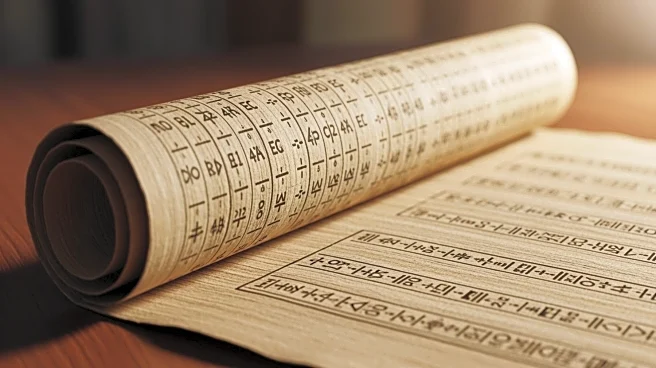
The Egyptian Mathematical Leather Roll is an example of a text that contains tables of unit fractions. These tables allowed scribes to rewrite any fraction as a sum of unit fractions, facilitating calculations in various applications, from trade to engineering.
Applications in Engineering and Measurement
Unit fractions were crucial in engineering and land measurement, where precise calculations were necessary. The Rhind Mathematical Papyrus includes problems that demonstrate the use of unit fractions in determining areas and volumes, essential for constructing pyramids and other structures.
During the New Kingdom, mathematical problems involving unit fractions are mentioned in literary texts such as the Papyrus Anastasi I. The Papyrus Wilbour records land measurements, indicating the practical applications of unit fractions in surveying and resource management.
Methods for Working with Unit Fractions
Egyptian scribes employed various methods to work with unit fractions, including the use of tables and algorithms. The method of mediation and duplation, a form of multiplication by doubling, was one technique used to simplify calculations involving fractions.
The Rhind Mathematical Papyrus contains examples of scribes using tables to convert fractions into sums of unit fractions. This process involved identifying the largest unit fraction that could be subtracted from the given fraction and repeating the process until the fraction was fully decomposed.
The use of unit fractions in Ancient Egyptian mathematics reflects a sophisticated understanding of numerical relationships and a practical approach to problem-solving. This system not only facilitated everyday calculations but also contributed to the development of mathematical concepts that influenced later civilizations.