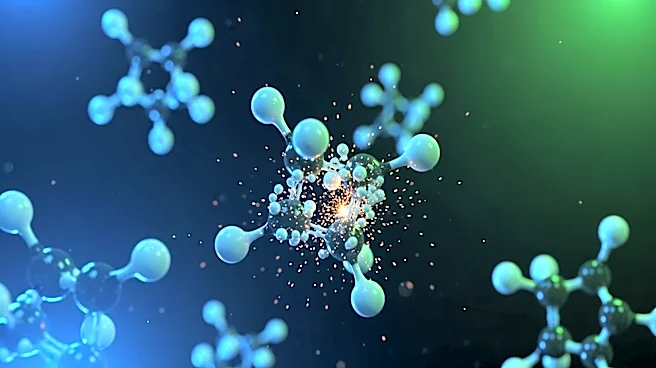







Free radicals are atoms, molecules, or ions with unpaired valence electrons, making them highly reactive. These radicals play a significant role in various chemical processes, including combustion, polymerization, and atmospheric chemistry. Understanding the formation and stability of free radicals is crucial for harnessing their reactivity in both industrial and biological contexts.
Formation of Free Radicals
Free radicals can be generated through several methods, including
redox reactions, ionizing radiation, heat, electrical discharges, and electrolysis. Homolysis, the breaking of covalent bonds to form radicals, is a common method of radical formation. For example, the homolysis of a bromine molecule produces two bromine radicals, while the homolysis of dibenzoyl peroxide results in benzoyloxy radicals.
Radicals can also form through reduction, where one-electron reductions create radical anions. These radicals are often unstable unless the charge can be delocalized, as seen in alkali metal naphthenides and ketyls. Additionally, radicals can be generated from other radicals through abstraction, addition, and elimination reactions.
Stability of Free Radicals
The stability of free radicals varies widely, with some being highly reactive and others relatively stable. Factors affecting radical stability include resonance delocalization, steric effects, and the presence of electron-donating or electron-withdrawing groups. For instance, the captodative effect stabilizes radicals by delocalizing the unpaired electron into both electron-donating and electron-withdrawing groups.
Singly-occupied molecular orbitals (SOMOs) play a crucial role in radical stability. Radicals with delocalized SOMOs are more stable, as the energy of these orbitals depends less on nuclear position. Organic radicals often have π-type SOMOs, which can delocalize into nearby lone pairs or conjugated π bonds, enhancing stability.
Implications for Chemical Reactions
Free radicals are intermediates in many chemical reactions, influencing processes such as polymerization and combustion. In polymerization, radicals add to alkenes, creating long-chain polymers. In combustion, radicals facilitate chain reactions that sustain the burning process.
Understanding the formation and stability of free radicals is essential for controlling their reactivity in industrial applications. By manipulating radical stability and reactivity, scientists can develop new materials and improve existing chemical processes, highlighting the importance of free radicals in modern chemistry.