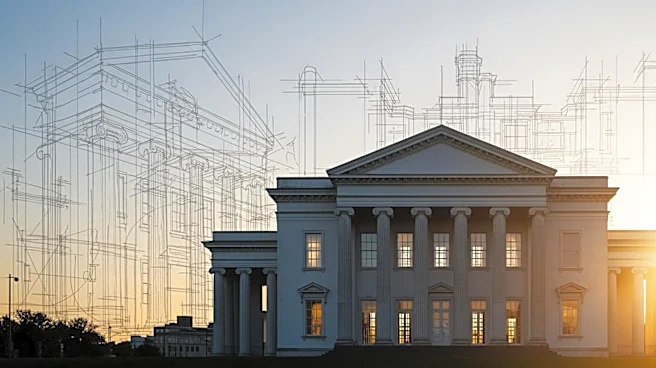




The White House, the official residence and workplace of the U.S. president, has undergone significant architectural changes since its construction. Located at 1600 Pennsylvania Avenue NW in Washington, D.C., it has been the home of every U.S. president since John Adams in 1800. The building's design and structure have evolved to accommodate the growing needs of the presidency and the nation.
Early Design and Construction
The White House was designed by Irish-born architect James
Hoban in the Neoclassical style, modeled after Leinster House in Dublin. Construction began in 1792 and was completed in 1800. The exterior walls were made of Aquia Creek sandstone painted white. When Thomas Jefferson moved in, he added low colonnades to conceal stables and storage.
In 1814, during the War of 1812, British forces set the mansion ablaze, destroying the interior and charring much of the exterior. Reconstruction began immediately, with President James Monroe moving into the partially rebuilt residence in 1817. The semicircular South Portico was added in 1824, followed by the North Portico in 1829.
Expansions and Renovations
Due to overcrowding, President Theodore Roosevelt relocated all work offices to the newly constructed West Wing in 1901. President William Howard Taft expanded the West Wing in 1909, creating the first Oval Office. The third-floor attic was converted to living quarters in 1927, and a new East Wing was completed in 1946.
By 1948, the residence's load-bearing walls were close to failure. Under President Harry S. Truman, the interior rooms were dismantled, and a new internal steel frame was constructed. The Truman Balcony was added, and the interior rooms were rebuilt.
Modern Developments
The present-day White House complex includes the Executive Residence, West Wing, Eisenhower Executive Office Building, and Blair House. In 2025, the Trump administration demolished the East Wing to make room for a new East Wing, including a ballroom funded through private donations.
The property is maintained by the National Park Service as part of the White House and President's Park. In 2007, it was ranked second on the American Institute of Architects list of America's Favorite Architecture. The White House continues to evolve, reflecting the changing needs and priorities of the presidency and the nation.