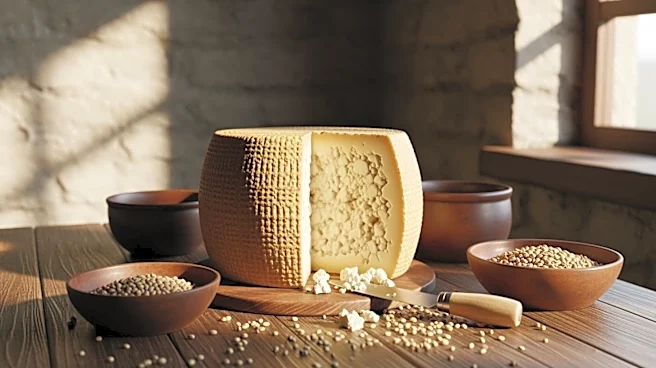







Cheese is a beloved food with a rich history that stretches back thousands of years. Its origins are so ancient that they predate recorded history, making it a fascinating subject for those interested in culinary traditions. While the exact location of its inception remains a mystery, cheese has been a staple in various cultures across Europe, Central Asia, and the Middle East. This article delves into the early history of cheese, exploring how it might
have been discovered and its significance in ancient societies.
Early Beginnings
The earliest proposed dates for the origin of cheesemaking go back to around 8000 BCE, coinciding with the domestication of sheep. It is believed that the process of cheese making was discovered accidentally. In ancient times, animal skins and inflated internal organs were used as storage vessels for food. Milk stored in a container made from an animal's stomach would have been exposed to rennet, an enzyme that causes milk to curdle, separating into curds and whey. This accidental discovery likely led to the intentional production of cheese.
There is a legend about an Arab trader who discovered cheese by storing milk in such a container. While this story is anecdotal, it highlights the serendipitous nature of cheese's discovery. The earliest archaeological evidence of cheesemaking dates back to 5500 BCE in what is now Poland, where milk-fat molecules were found on ancient strainers. This suggests that cheese was being made and consumed in Europe long before it was documented in written records.
Cheese in Ancient Civilizations
Cheese played a significant role in ancient civilizations, as evidenced by its presence in Egyptian tomb murals dating back to 2000 BCE. A scientific study in 2018 even found cheese dating to approximately 1200 BCE in ancient Egyptian tombs. This indicates that cheese was not only a food source but also held cultural significance in ancient Egypt.
In ancient Greece, cheese was attributed to the mythical figure Aristaeus, and it was mentioned in Homer's "Odyssey" as a staple in the diet of the Cyclops. The Greeks and Romans both valued cheese, with the latter developing sophisticated cheesemaking techniques. Pliny the Elder, a Roman author, wrote about the diversity of cheeses available in the Roman Empire, noting their variety and the regions they came from.
The Spread of Cheesemaking
As cheese spread across Europe, it became an integral part of various cultures. By the Middle Ages, many of the cheeses we know today, such as Cheddar and Parmesan, were being produced. The spread of cheese was facilitated by the Roman Empire, which introduced cheesemaking to new regions as it expanded.
Cheese's long shelf life and portability made it an essential food for travelers and soldiers. Its ability to be stored for long periods without spoiling meant it could be transported over great distances, further aiding its spread. Today, cheese is enjoyed worldwide, with each region offering its unique varieties and flavors, all tracing back to those ancient origins.