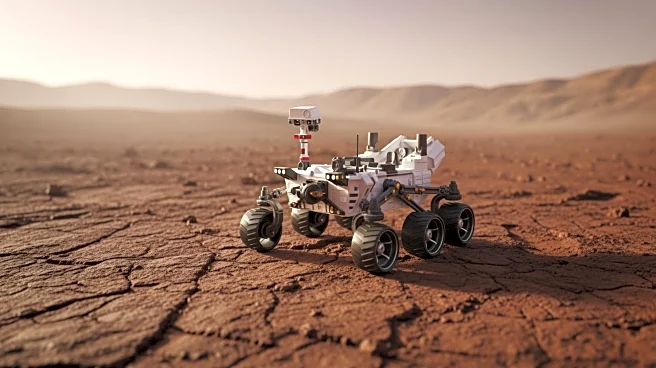




The Sojourner rover, part of NASA's Mars Pathfinder mission, was a trailblazer in the field of planetary exploration. As the first rover to operate on Mars, Sojourner conducted a series of scientific experiments that provided valuable insights into the Martian environment. This article explores the scientific contributions of Sojourner, highlighting its experiments and the data it collected during its mission.
Analyzing Martian Rocks and Soil
One of Sojourner's primary scientific
objectives was to analyze the chemical composition of Martian rocks and soil. To achieve this, the rover was equipped with an Alpha Proton X-ray Spectrometer (APXS), a sophisticated instrument designed to detect the presence of various elements. The APXS worked by bombarding samples with alpha particles and measuring the resulting X-rays, which provided information about the elements present in the samples.
During its mission, Sojourner conducted 16 analyses of rocks and soil, revealing important details about the Martian surface. The data collected by the APXS indicated the presence of andesitic rocks, suggesting past volcanic activity on Mars. This finding was significant, as it provided evidence of geological processes that may have shaped the planet's surface over time.
Atmospheric and Environmental Observations
In addition to analyzing rocks and soil, Sojourner contributed to our understanding of the Martian atmosphere and environmental conditions. The rover was equipped with front and rear cameras, which captured 550 images of the Martian landscape. These images provided valuable information about the planet's terrain, weather patterns, and potential for past water activity.
Sojourner's observations of the Martian environment helped scientists better understand the planet's climate and atmospheric conditions. The data collected by the rover contributed to the development of models that simulate Mars' weather patterns, providing insights into the planet's past and present climate.
Legacy and Impact on Future Missions
Sojourner's scientific contributions were instrumental in advancing our understanding of Mars and its potential for past habitability. The data collected by the rover provided a foundation for future exploration missions, such as the Mars Exploration Rovers Spirit and Opportunity, which built upon Sojourner's findings to further investigate the planet's geology and climate.
The success of Sojourner's mission demonstrated the value of using rovers for planetary exploration, paving the way for more advanced missions to the Red Planet. Its scientific achievements not only expanded our knowledge of Mars but also inspired a new era of exploration, with subsequent missions continuing to build on Sojourner's legacy.
In conclusion, Sojourner's scientific contributions to Mars exploration were significant and far-reaching. Its experiments and findings provided valuable insights into the Martian environment, setting the stage for future missions to continue the quest for knowledge about our neighboring planet.