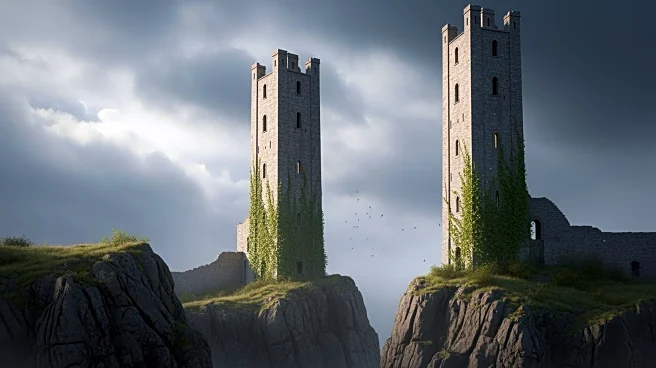




In J.R.R. Tolkien's 'The Two Towers,' the concept of towers plays a significant symbolic role. The title itself suggests a focus on these structures, which represent power, isolation, and duality. This article examines the symbolic significance of towers in the narrative and how they contribute to the themes of the story.
Towers as Symbols of Power
Towers in 'The Two Towers' are emblematic of power and authority. Orthanc, the black tower of Isengard, is a symbol of Saruman's
ambition and his fall from grace. Once a place of wisdom, it becomes a fortress of corruption as Saruman aligns himself with Sauron. The tower's imposing presence reflects Saruman's desire for control and domination, serving as a physical manifestation of his inner darkness.
Similarly, Barad-dûr, the Dark Tower of Sauron, represents the ultimate evil and tyranny. Its looming presence over Mordor is a constant reminder of Sauron's oppressive power. The tower's dark and foreboding nature underscores the threat it poses to Middle-earth, symbolizing the central conflict between good and evil.
Isolation and Duality
Towers also symbolize isolation and duality in the narrative. Orthanc and Barad-dûr stand as solitary structures, isolated from the world around them. This isolation reflects the separation of their inhabitants from the rest of Middle-earth, highlighting the divide between those who seek power for themselves and those who fight for the greater good.
The duality of towers is further emphasized by Tolkien's ambiguous identification of the titular two towers. In various interpretations, the towers could be Orthanc and Barad-dûr, Minas Tirith and Barad-dûr, or Orthanc and the Tower of Cirith Ungol. This ambiguity reflects the complex nature of the conflict, where alliances and enmities are not always clear-cut.
Towers and the Theme of Hope
Despite their association with power and isolation, towers in 'The Two Towers' also embody the theme of hope. Minas Tirith, the White Tower, stands as a beacon of hope and resistance against the encroaching darkness. Its gleaming presence contrasts with the dark towers of Orthanc and Barad-dûr, symbolizing the resilience of those who fight for freedom and justice.
The destruction of Isengard and the entrapment of Saruman within Orthanc serve as a turning point in the story, offering hope that evil can be overcome. The Ents' attack on Isengard demonstrates the power of nature and unity against tyranny, reinforcing the idea that even the mightiest towers can fall.
In conclusion, the symbolism of towers in 'The Two Towers' enriches the narrative by highlighting themes of power, isolation, duality, and hope. Through these structures, Tolkien weaves a complex tapestry of meaning that enhances the epic struggle between good and evil in Middle-earth.