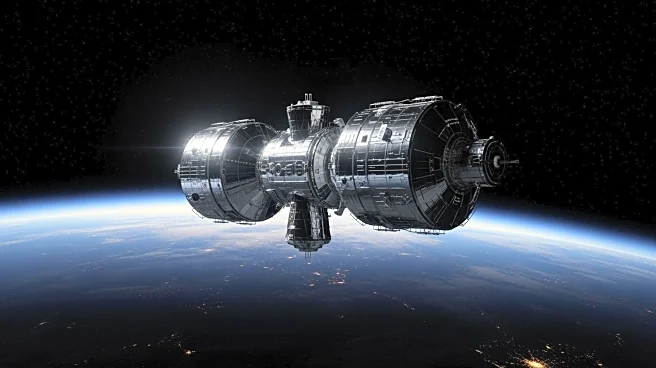

The International Space Station (ISS) is a marvel of modern engineering and international collaboration. Its development and assembly have been marked by significant milestones that have shaped its current
form. From its initial conception to its continuous habitation, the ISS has evolved into a sophisticated platform for scientific research and exploration.
Early Conception and Initial Launches
The ISS program began by combining two previously planned crewed Earth-orbiting stations: the United States' Space Station Freedom and the Soviet Union's Mir-2. The first module of the ISS, Zarya, was launched in 1998, marking the beginning of the station's assembly in space. Zarya provided essential functions such as propulsion, attitude control, and power.
Shortly after, the American-built Unity module was launched and joined with Zarya. Unity served as the connection between the Russian and U.S. segments of the station, paving the way for future expansions. These initial modules laid the groundwork for the ISS's development, setting the stage for continuous human presence in space.
Expansion and Continuous Habitation
The turning point for the ISS came in July 2000 with the launch of the Zvezda module, which provided living quarters and life-support systems. This enabled the first long-term crew, Expedition 1, to arrive in November 2000, marking the beginning of continuous human habitation on the station.
Over the following years, the ISS expanded with the addition of various modules and components. The Destiny laboratory, Quest airlock, and Canadarm2 were among the significant additions that enhanced the station's capabilities. Despite setbacks, such as the loss of the Space Shuttle Columbia in 2003, the assembly of the ISS continued, with new modules and solar arrays being added to support its growing functions.
Recent Developments and Future Prospects
In recent years, the ISS has continued to evolve with the addition of new modules like the Nauka and Prichal, further enhancing its research capabilities. The station's structure now includes 43 different modules and elements, making it the largest space station ever constructed.
Looking ahead, the ISS is expected to remain operational until 2030, with plans for its eventual de-orbiting. However, its legacy will continue to inspire future space exploration endeavors. The ISS has not only advanced our understanding of space but also demonstrated the power of international collaboration in achieving complex scientific and engineering goals.