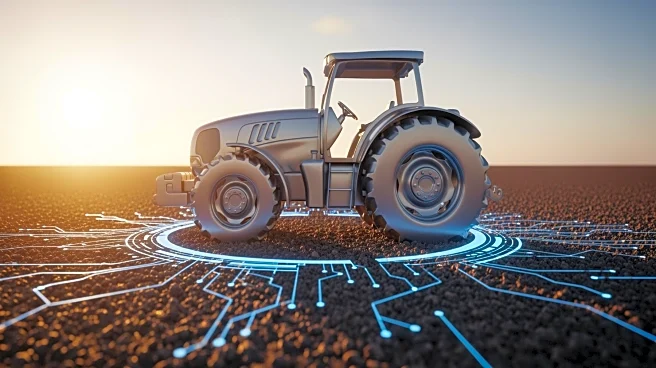




Driverless tractors represent a significant leap in agricultural technology, offering a glimpse into the future of farming. These autonomous vehicles have evolved over decades, driven by the need for efficiency and precision in agricultural tasks. From early concepts to modern implementations, driverless tractors have transformed the way farmers approach their work, maximizing productivity while minimizing human intervention.
Early Concepts and Developments
The idea of driverless
tractors dates back to 1940 when Frank W. Andrew invented a tractor that could operate without a human driver. This early model used a cable system to guide the tractor around a field, marking the beginning of autonomous agricultural machinery. Despite its innovative approach, the technology was limited by the need for physical guidance systems.
In the 1950s, Ford developed "The Sniffer," a driverless tractor that relied on underground wires for navigation. However, this model was never mass-produced due to its impracticality. It wasn't until 1994 that significant advancements were made with the development of a picture analysis system by the Silsoe Research Institute, which guided small driverless tractors for vegetable and root crops.
Technological Advancements
The 1980s marked a major shift in agricultural technology with the introduction of precision agriculture. This approach utilized GPS devices and on-board computers to enhance the efficiency of tractors, allowing farmers to maximize returns while using minimal resources. By 2011, semi-automated tractors emerged, requiring drivers only to steer at the end of each row.
The concept of fully autonomous tractors gained traction in the early 2010s, with technologies evolving to allow tractors to operate independently. These tractors use GPS and wireless technologies to navigate fields, with supervisors monitoring their progress from control stations. Modern driverless tractors are equipped with sensors to detect obstacles, ensuring safe operation.
Current Innovations and Future Prospects
Today, driverless tractors are at the forefront of agricultural automation. Companies like John Deere and Autonomous Tractor Corporation are leading the charge, developing prototypes that utilize advanced technologies such as stereo cameras and Nvidia GPUs. These tractors can be controlled remotely via smartphones, offering unprecedented convenience and efficiency.
The future of driverless tractors looks promising, with ongoing research focused on enhancing their capabilities. As technology continues to advance, these autonomous vehicles are expected to play a crucial role in addressing labor shortages and increasing agricultural productivity. The evolution of driverless tractors is a testament to the power of innovation in transforming traditional farming practices.