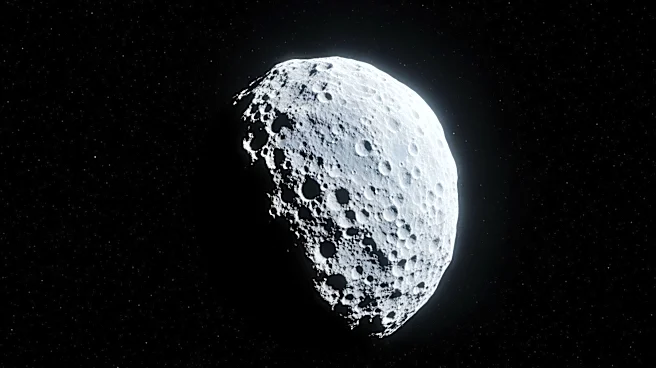




4 Vesta stands out as one of the most remarkable objects in the asteroid belt. Known for its brightness and size, Vesta offers a unique opportunity to study the characteristics of asteroids. This article explores the physical attributes of Vesta and its significance as a visible celestial body.
Physical Characteristics of 4 Vesta
4 Vesta is notable for its substantial size, with a mean diameter of approximately 525 kilometers. This makes it the second-largest object in the asteroid belt,
following the dwarf planet Ceres. Vesta's size is a key factor in its visibility and its importance in astronomical studies. Its mass and volume contribute to its gravitational influence within the asteroid belt, affecting the orbits of nearby bodies.
The surface of Vesta is composed of a variety of materials, which reflect light in a way that makes it one of the brightest asteroids visible from Earth. This brightness is due to its high albedo, a measure of how much light an object reflects. Vesta's albedo is significantly higher than that of many other asteroids, making it a prominent feature in the night sky.
Visibility and Observations
One of the most intriguing aspects of 4 Vesta is its visibility to the naked eye. Under favorable conditions, Vesta can be seen without the aid of telescopes, a rarity for objects in the asteroid belt. This visibility has made it a subject of interest for both amateur and professional astronomers.
The brightness of Vesta is not only a result of its size and albedo but also its proximity to Earth during certain periods of its orbit. As Vesta moves along its path, it occasionally comes closer to Earth, enhancing its visibility. These periods provide valuable opportunities for observation and study, allowing astronomers to gather data on its surface and composition.
Scientific Importance of Vesta
The study of 4 Vesta has yielded significant insights into the nature of asteroids and the history of the solar system. Its size and brightness make it an ideal candidate for space missions and detailed observations. The Dawn spacecraft, for example, provided extensive data on Vesta's surface and geological history, contributing to our understanding of asteroid formation and evolution.
Vesta's unique characteristics also offer clues about the early solar system. By studying its composition and structure, scientists can infer the processes that occurred during the formation of the solar system. This information is crucial for developing models of planetary formation and understanding the distribution of materials in the early solar system.
In summary, 4 Vesta is a remarkable object in the asteroid belt, distinguished by its size, brightness, and visibility. Its study continues to provide valuable insights into the nature of asteroids and the history of our solar system, making it a focal point for astronomical research.