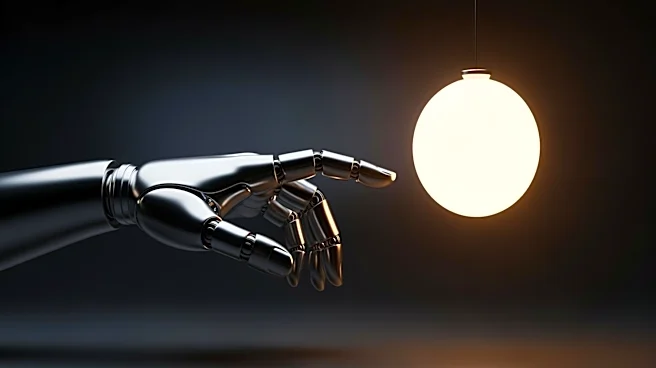








Developmental robotics is an emerging field that leverages intrinsic motivation to enhance the learning capabilities of robots. By focusing on curiosity-driven learning, researchers aim to develop robots that can autonomously explore and adapt to their environments. This approach is inspired by the psychological concept of intrinsic motivation, where actions are driven by inherent satisfaction rather than external rewards.
Curiosity-Driven Learning in Robotics
In developmental robotics,
intrinsic motivation is used to enable robots to exhibit behaviors such as exploration and curiosity. These behaviors are inherently rewarding and are crucial for autonomous learning. The idea is that robots are intrinsically motivated to act if the information content or the experience resulting from the action is the motivating factor. This approach contrasts with extrinsic motivation, which is typically task-dependent or goal-directed.
Curiosity-driven learning has been studied extensively in reinforcement learning models, where robots are encouraged to explore as much of the environment as possible. The goal is to reduce uncertainty about the dynamics of the environment and learn how best to achieve their goals. By focusing on aspects of the environment that confer more information, robots can efficiently explore and adapt to new situations.
Autonomous Lifelong Learning
Intrinsically motivated learning in developmental robotics aims to develop robots that can learn general skills or behaviors that improve performance in extrinsic tasks. This approach has been studied as a method for autonomous lifelong learning in machines and open-ended learning in computer game characters. By learning meaningful abstract representations, robots can gauge novelty and efficiently explore their environments.
Despite the impressive success of deep learning in specific domains, such as AlphaGo, the ability to generalize remains a fundamental challenge in robotics. Intrinsically motivated learning, while promising, faces the same challenge of generalization. Researchers are working on ways to reuse policies or action sequences, compress and represent complex state spaces, and retain and reuse salient features that have been learned.
Future Directions in Robotics
The future of intrinsically motivated developmental robotics lies in overcoming the challenges of generalization and developing robots that can learn and adapt autonomously. By focusing on intrinsic motivation, researchers hope to create robots that are not only capable of performing specific tasks but can also explore and learn from their environments in a meaningful way.
Understanding the application of intrinsic motivation in developmental robotics provides valuable insights into how robots can be designed to mimic human-like learning and exploration. By leveraging intrinsic motivation, researchers aim to enhance the learning capabilities of robots, ultimately improving their performance in various tasks and environments.