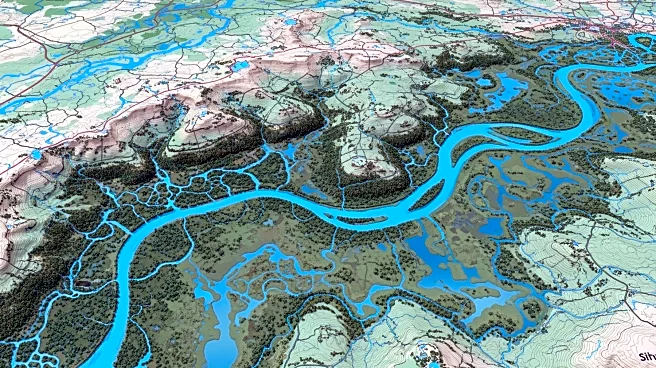

The Battle of New Bern, fought on March 14, 1862, was a significant engagement during the American Civil War. The geography of the region played a crucial role in the battle's outcome, influencing both
the Union and Confederate strategies. Understanding the geographical context of New Bern provides insight into the tactical decisions made by both sides.
The Strategic Location of New Bern
New Bern's location on the Neuse River made it a strategic target for Union forces. Situated about 37 miles from Pamlico Sound, the river was navigable for vessels, making New Bern a valuable seaport. Although its importance as a port had diminished by the Civil War, the city remained a strategic military target due to its connection to the Atlantic and North Carolina Railroad. This railroad linked the coast with the interior and intersected with the Wilmington and Weldon Railroad at Goldsboro, a crucial supply line for the Confederate Army of Northern Virginia.
The Union's control of New Bern disrupted this supply chain, weakening the Confederate war effort. The city's strategic location made it a key objective for Union forces seeking to gain control of North Carolina and disrupt Confederate logistics.
The Terrain and Its Impact on the Battle
The terrain around New Bern significantly influenced the battle's tactics. The area is characterized by low, flat land, with marshy regions and open pine forests. The Neuse River and its tributaries, such as the Trent River and Slocum's Creek, further shaped the battlefield. The Union forces landed at Slocum's Creek, 16 miles down the Neuse River from New Bern, and advanced towards the city.
The Confederate defenses were anchored on Fort Thompson, with a series of breastworks extending inland. However, the decision to use a small creek as part of the defensive line created a dogleg in the center, which proved to be a fatal flaw. The Union forces exploited this weakness, penetrating the Confederate line and forcing a retreat.
The Influence of Geography on Military Strategy
The geography of New Bern influenced the military strategies of both sides. For the Union, the navigable Neuse River allowed for the deployment of naval gunboats to support the land assault. The river's width and depth enabled the Union forces to transport troops and supplies efficiently, providing a logistical advantage.
For the Confederates, the terrain presented challenges in defending against the Union assault. The marshy land and dense forests limited the mobility of Confederate forces and made it difficult to reinforce positions. The natural features of the area, such as the Neuse River and the surrounding marshlands, played a significant role in shaping the battle's outcome.
In conclusion, the geography of New Bern was a critical factor in the battle's outcome. The strategic location, terrain, and natural features influenced the tactics and strategies employed by both Union and Confederate forces, ultimately contributing to the Union victory.