


Trikonasana, or the Extended Triangle Pose, is a versatile yoga asana with several variations that cater to different levels of practice and physical capabilities. Each variation offers unique benefits and challenges, allowing practitioners to explore the pose's full potential. Understanding these variations and techniques can enhance one's yoga practice and deepen the experience of Trikonasana.
Basic Technique
The basic form of Trikonasana involves standing with
feet one leg-length apart, knees unbent, and arms extended parallel to the ground. The right foot is turned completely to the outside, while the left foot is angled slightly inward. The trunk is extended to the right, and the right hand reaches down to the shin, a block, or the floor, while the left arm extends vertically.
This foundational technique emphasizes alignment and balance. The spine and trunk are gently twisted, using the arms as a lever to enhance the stretch. The head may be turned to gaze at the left thumb, adding a subtle twist to the neck. This basic form of Trikonasana is accessible to most practitioners and serves as a starting point for exploring more advanced variations.
Advanced Variations
Trikonasana offers several advanced variations that increase the pose's complexity and intensity. One such variation is Parivrtta Trikonasana, or the Revolved Triangle Pose. In this version, the trunk is rotated more strongly, and the opposite hand reaches towards the foot, creating a deeper twist.
Another advanced variation is Baddha Trikonasana, or the Bound Triangle Pose. Here, the arms are bound behind the back, requiring greater flexibility and strength. This variation challenges the practitioner to maintain balance while deepening the stretch across the chest and shoulders. These advanced forms of Trikonasana provide opportunities for growth and exploration, pushing the boundaries of one's practice.
Incorporating Trikonasana into Practice
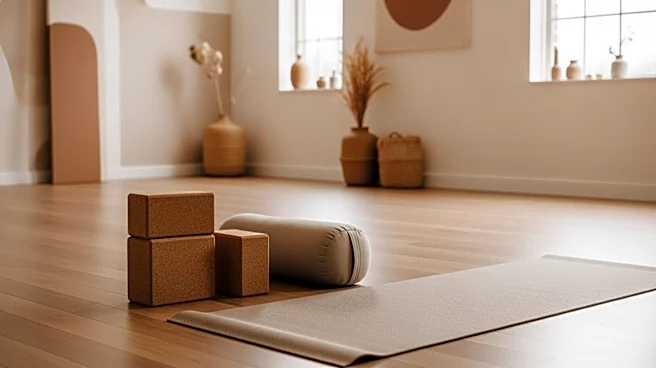
Incorporating Trikonasana and its variations into a yoga practice can enhance physical and mental well-being. The pose strengthens the legs, stretches the hips and spine, and improves balance and concentration. Practitioners can modify the pose to suit their needs, using props like blocks or straps to support their alignment.
Different schools of yoga may emphasize various aspects of Trikonasana. For example, Iyengar Yoga focuses on precise alignment and the use of props, while Ashtanga Yoga incorporates the pose into a dynamic sequence. By exploring these different approaches, practitioners can discover new dimensions of Trikonasana and its role in their practice.
In summary, Trikonasana is a multifaceted pose with numerous variations and techniques. Whether practicing the basic form or exploring advanced variations, Trikonasana offers a wealth of benefits and challenges. By understanding and incorporating these variations, practitioners can enrich their yoga journey and experience the full potential of this iconic pose.