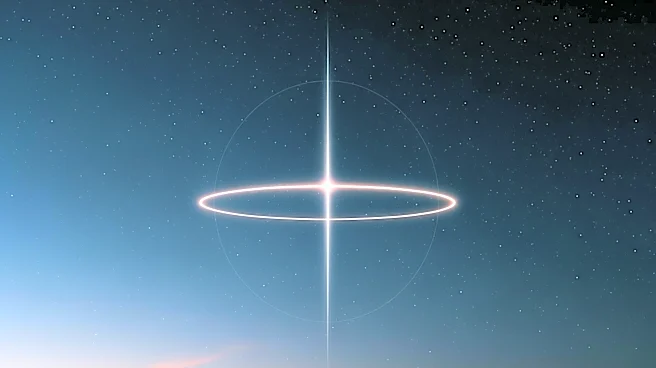





The celestial equator is a fundamental concept in astronomy, serving as an imaginary extension of Earth's equator into space. This great circle on the celestial sphere is crucial for understanding the movement of celestial bodies and is a key reference point in the equatorial coordinate system. For those new to astronomy, grasping the celestial equator's role can enhance the appreciation of how we observe and map the stars.
The Celestial Sphere and Equator
The celestial equator is
part of the celestial sphere, an imaginary sphere that surrounds Earth. This sphere is used by astronomers to map the positions of stars and other celestial objects. The celestial equator itself is the projection of Earth's equator onto this sphere, creating a great circle that divides the sky into northern and southern hemispheres. This alignment makes it a vital reference in the equatorial coordinate system, which is used to specify the positions of celestial objects.
Due to Earth's axial tilt, the celestial equator is inclined by about 23.44° relative to the ecliptic, which is the plane of Earth's orbit around the Sun. This tilt is not constant; it has varied between 22.0° and 24.5° over the past five million years due to Milankovitch cycles and gravitational perturbations from other planets. These variations affect how we observe celestial phenomena and are important for long-term astronomical studies.
Observing the Celestial Equator
For an observer standing on Earth's equator, the celestial equator appears as a semicircle passing directly overhead through the zenith. As one moves north or south, the celestial equator tilts toward the opposite horizon. This means that from any location on Earth, the celestial equator intersects the horizon at points due east and due west. At the poles, the celestial equator aligns with the astronomical horizon, providing a unique perspective on the sky.
Astronomical objects near the celestial equator are visible from most places on Earth, making them accessible to a wide range of observers. These objects reach their highest point in the sky, or culminate, when viewed from locations near Earth's equator. This accessibility makes the celestial equator a valuable tool for both amateur and professional astronomers.
The Celestial Equator's Role in Astronomy
The celestial equator is not only a tool for observation but also a critical component in the equatorial coordinate system. This system, which includes right ascension and declination, allows astronomers to pinpoint the location of celestial objects with precision. Right ascension measures the angular distance of an object eastward along the celestial equator, while declination measures the angular distance north or south of the celestial equator.
Understanding the celestial equator and its role in the equatorial coordinate system is essential for anyone interested in astronomy. It provides a framework for observing the sky and helps astronomers track the movement of stars and planets. By learning about the celestial equator, one gains a deeper appreciation for the complexity and beauty of the universe.