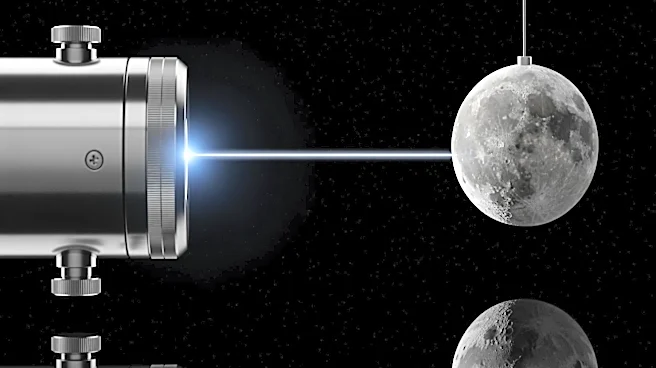






Lunar Laser Ranging (LLR) experiments have played a crucial role in advancing our understanding of the Earth-Moon system. These experiments involve measuring the distance between the Earth and the Moon using laser pulses. The history of LLR is marked by significant milestones, starting from the early 1960s to the present day, with each phase contributing to the precision and scope of lunar measurements.
Early Beginnings
The journey of lunar laser ranging began in 1962
when Louis Smullin and Giorgio Fiocco from the Massachusetts Institute of Technology successfully observed laser pulses reflected from the Moon's surface. This initial success was achieved using a laser with a 50J 0.5 millisecond pulse length. Around the same time, a Soviet team at the Crimean Astrophysical Observatory also conducted similar measurements using a Q-switched ruby laser. These early experiments laid the groundwork for more precise measurements by demonstrating the feasibility of using lasers to measure the Earth-Moon distance.
Shortly after these initial tests, James Faller, a graduate student at Princeton University, proposed the idea of placing optical reflectors on the Moon to improve measurement accuracy. This proposal led to the installation of retroreflector arrays on the Moon by the Apollo 11 mission in 1969, marking a significant advancement in the field.
Advancements in Precision
The installation of retroreflectors by the Apollo missions (11, 14, and 15) and the Soviet Lunokhod rovers significantly enhanced the precision of lunar distance measurements. The first successful measurements using these reflectors were reported on August 1, 1969, by the Lick Observatory. Over the years, various observatories, including the McDonald Observatory in Texas and the Pic du Midi Observatory in France, contributed to the growing body of data.
The Apollo 15 mission's retroreflector array, being three times the size of the earlier ones, became the primary target for measurements, accounting for three-quarters of the data collected in the first 25 years. This period saw significant improvements in technology, allowing for more precise measurements and the use of smaller arrays.
Modern Developments
In recent years, the Apache Point Observatory Lunar Laser-ranging Operation (APOLLO) in New Mexico has further advanced the precision of LLR experiments. By utilizing a large telescope and a site with good atmospheric conditions, APOLLO has achieved millimeter-level accuracy in measuring the Earth-Moon distance. This level of precision allows scientists to test various aspects of gravitational theories and the dynamics of the Earth-Moon system.
The ongoing advancements in LLR technology continue to provide valuable insights into the fundamental physics of our universe, demonstrating the enduring importance of these experiments in scientific research.