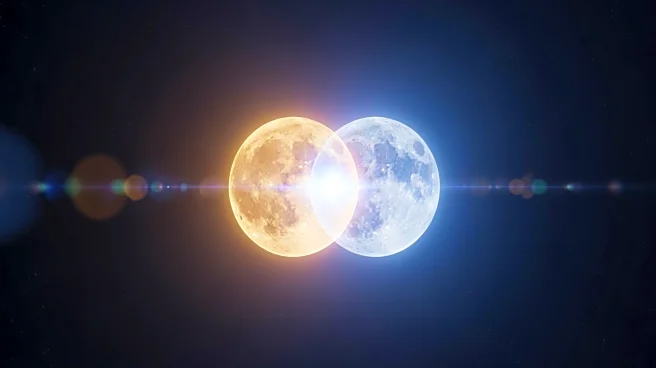

In the realm of astronomy, conjunctions are fascinating events where two celestial bodies appear close together in the sky. This phenomenon is not due to the actual proximity of these objects in space
but rather a result of their alignment from the perspective of an observer on Earth. Conjunctions can involve planets, the Moon, or even distant stars, and they offer a unique opportunity to observe the dance of celestial bodies across the night sky.
The Mechanics of Conjunctions
A conjunction occurs when two astronomical objects have the same right ascension or ecliptic longitude. This alignment is typically observed from Earth, where the two objects appear to be near each other in the sky. The ecliptic is the apparent path of the Sun across the sky, and many planets and the Moon travel close to this path, making conjunctions more frequent among these bodies.
Conjunctions can involve two objects within the Solar System or one object from the Solar System and a more distant star. Despite their apparent closeness, the objects involved in a conjunction are not physically near each other in space. This is purely an observational phenomenon, highlighting the importance of perspective in astronomy.
Types of Conjunctions
There are different types of conjunctions based on the celestial coordinate system used. In right ascension, a conjunction occurs when two objects share the same hour angle. In ecliptic longitude, it happens when they share the same ecliptic longitude. These two types of conjunctions do not always occur simultaneously, but they often happen close together in time.
A special case is the triple conjunction, where the same two planets align three times over a short period due to their retrograde motion. This occurs when one planet appears to move backward in the sky relative to the stars, a result of the relative motion of Earth and the planet involved.
Observing Conjunctions
Conjunctions are best observed when the involved celestial bodies are bright and close to the ecliptic. For instance, conjunctions between two bright planets like Venus and Jupiter can be seen with the naked eye. The visibility of a conjunction depends on the time of day and the observer's location on Earth.
The position of the observer can slightly affect the timing and appearance of a conjunction, especially for those involving the Moon due to its proximity to Earth. However, for most conjunctions, the differences are minimal, allowing observers worldwide to enjoy these celestial events.
Conjunctions offer a captivating glimpse into the movements of celestial bodies and serve as a reminder of the dynamic nature of our universe. Whether viewed through a telescope or with the naked eye, these events continue to inspire awe and curiosity among astronomers and stargazers alike.