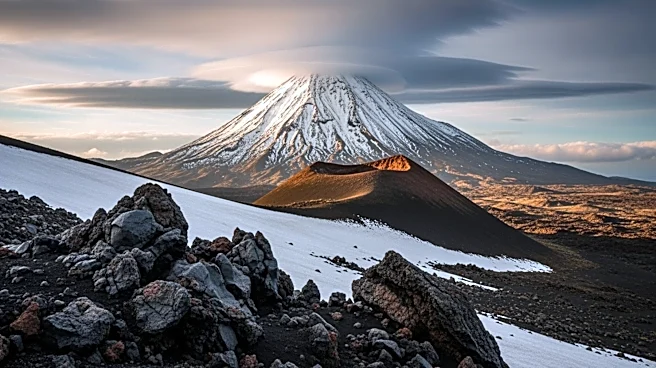






Lassen Peak, located in Northern California, is a significant part of the Cascade Range and has a rich history of volcanic activity. This article provides a chronological exploration of Lassen Peak's eruptive history, highlighting key events and their impact on the surrounding region.
Early Eruptive Activity
The volcanic activity at Lassen Peak began around 600,000 years ago with the formation of Mount Tehama, a large stratovolcano. Mount Tehama eventually collapsed, leaving
behind remnants such as Brokeoff Mountain and Mount Diller. Lassen Peak itself formed approximately 27,000 years ago, emerging as a lava dome from the northern flank of Mount Tehama.
The peak's early eruptions were characterized by the extrusion of dacite lava, which formed steep-sided domes. These eruptions were part of a broader pattern of volcanic activity in the region, which included the formation of other dacite domes like Chaos Crags.
20th Century Eruptions
Lassen Peak's most notable eruptions occurred in the early 20th century. On May 30, 1914, the volcano became active again after 27,000 years of dormancy, producing a steam explosion that carved out a small crater. This marked the beginning of a series of eruptions that lasted until 1921.
The most significant eruption occurred on May 22, 1915, when Lassen Peak produced a violent explosive eruption. This event ejected rock and pumice, forming a large crater at the summit. The eruption column reached altitudes of over 30,000 feet and was visible from as far as 150 miles away. The eruption also generated pyroclastic flows and lahars, which caused significant damage to the surrounding area.
Post-Eruption Activity
Following the major eruptions of 1915, Lassen Peak continued to exhibit volcanic activity through steam explosions and minor eruptions. In May 1917, a strong steam explosion formed a new crater at the summit, with eruptions lasting two days. Additional steam eruptions occurred in 1919 and 1920, further altering the summit's landscape.
Since 1921, Lassen Peak has remained dormant, although geothermal activity persists in the area. The presence of fumaroles, hot springs, and mudpots indicates that the volcano is still active beneath the surface. The California Volcano Observatory monitors the region closely, as the potential for future eruptions remains.
Lassen Peak's eruptive history is a testament to the dynamic nature of the Earth's geology. Its eruptions have shaped the landscape and continue to influence the region's ecology and climate.