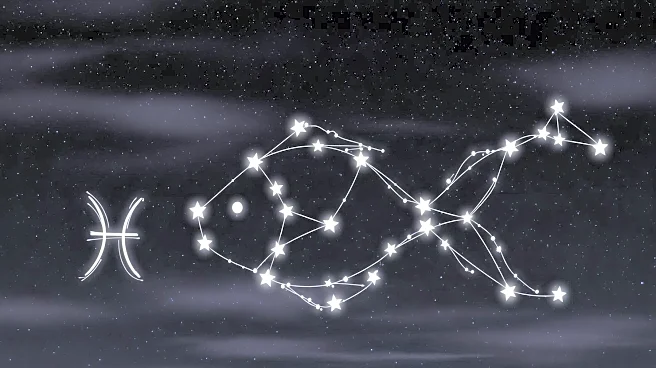

Pisces is a fascinating constellation that holds a significant place in the zodiac. Located on the celestial equator, it spans from 330° to 360° of celestial longitude. This constellation is bordered by Aquarius to the southwest and Aries to the east. Despite its large size, Pisces is known for its dimness, making it a challenge to observe in areas with significant light pollution. The constellation's brightest star is η Psc, also known as Alpherg.
The Position and Structure of Pisces
Pisces is a zodiac constellation that straddles the celestial equator. It is positioned between Aquarius and Aries, making it a part of the zodiac belt that is familiar to many. The constellation is notable for its vast bulk, which is primarily located in the Northern celestial hemisphere. The main asterism of Pisces is traditionally viewed as a pair of fishes connected by cords, a depiction that dates back to Greco-Roman antiquity.
The ecliptic and the celestial equator intersect within Pisces, specifically at the first point of Aries. This intersection is significant because it marks the location where the Sun passes directly overhead of the equator during the March equinox. This celestial event is a key marker in the astronomical calendar, signifying the transition from winter to spring in the Northern Hemisphere.
Stars and Visibility
Despite its size, Pisces is the second dimmest of the zodiac constellations, with only two stars brighter than magnitude 4. This dimness makes it difficult to observe in urban areas where light pollution is prevalent. The brightest star in Pisces is η Psc, or Alpherg, which has an apparent magnitude of 3.62. This star, along with others in the constellation, forms part of the asterism that represents the two fishes.
Pisces contains 18 main stars and 86 Bayer/Flamsteed stars. However, none of these stars are brighter than magnitude 3.00, which contributes to the constellation's overall dimness. Additionally, there are eight stars within 10 parsecs (approximately 32.62 light-years) of Earth, but these too are not particularly bright.
Deep-Sky Objects and Meteor Showers
Pisces is home to several interesting deep-sky objects, including the Messier 74, also known as the Phantom Galaxy. This spiral galaxy is located about 30 million light-years away and is known for its loosely wound structure and regions of star formation. The constellation also hosts the Piscids meteor shower, which is an annual event that can be observed when conditions are favorable.
Overall, Pisces is a constellation rich in history and astronomical significance. Its position on the celestial equator and its role in marking the March equinox make it an important feature of the night sky, despite its relative dimness compared to other constellations.