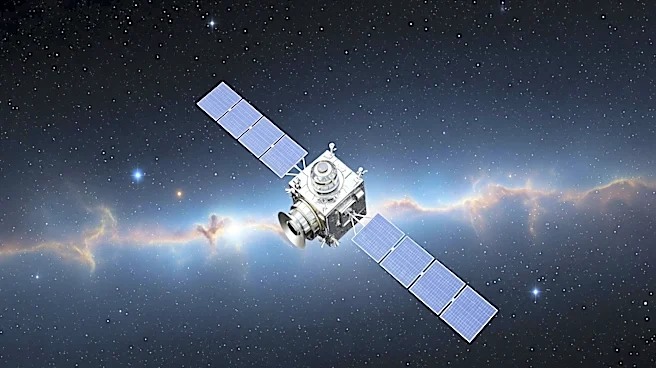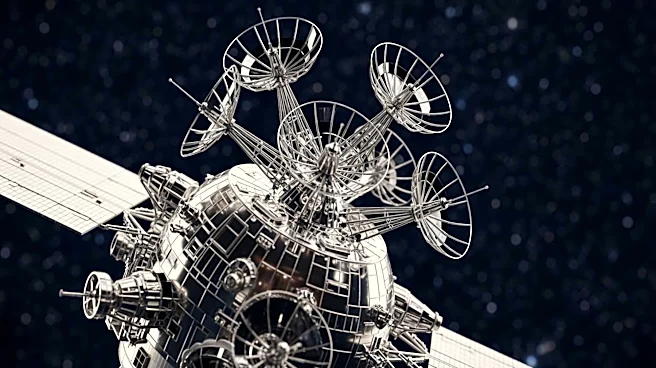

Pioneer 11 was not just a space probe; it was a technological marvel that showcased the ingenuity and innovation of its time. This article examines the technological advancements and design features of Pioneer 11 that enabled
its successful mission to the outer Solar System.
Spacecraft Design and Instruments
Pioneer 11 was built by TRW and managed by NASA Ames Research Center as part of the Pioneer program. The spacecraft's design was compact yet robust, featuring a hexagonal structure with six panels housing its scientific instruments. The bus measured 36 centimeters deep, with a mass of 259 kilograms, making it lightweight yet capable of carrying a suite of instruments for its mission.
The spacecraft was equipped with twelve scientific instruments, including a flux-gate magnetometer, which was an addition to its predecessor, Pioneer 10. These instruments were crucial for studying the magnetic fields, cosmic rays, and the interplanetary medium. The data collected by these instruments provided valuable insights into the environments of Jupiter and Saturn, as well as the solar wind and cosmic rays.
Communication and Power Systems
Communication with Pioneer 11 was facilitated by a redundant system of transceivers, each transmitting data across the S-band. The spacecraft used a high-gain antenna to maintain contact with Earth, with the Deep Space Network tracking its signal. This communication system was vital for transmitting the data collected by the probe back to Earth.
Powering Pioneer 11 were four SNAP-19 radioisotope thermoelectric generators (RTGs), positioned on trusses to minimize interference with the scientific instruments. These RTGs provided 155 watts of power at launch, which decayed to 140 watts during its journey to Jupiter. The spacecraft required 100 watts to power all its systems, ensuring it could operate effectively throughout its mission.
Navigational and Computational Capabilities
Pioneer 11's navigation relied on its attitude control and propulsion systems, which used propellant to adjust the probe's orientation. The spacecraft's trajectory was carefully planned, with mid-course corrections made to ensure its successful flybys of Jupiter and Saturn.
The probe's computational capabilities were limited, with much of the mission's computation performed on Earth. Pioneer 11 could retain up to five commands in memory, with a data storage unit capable of recording 6,144 bytes of information. Despite these limitations, the spacecraft's digital telemetry unit effectively prepared and transmitted the collected data back to Earth.
Pioneer 11's technological innovations and design were instrumental in its success. The spacecraft's ability to navigate the outer Solar System and transmit valuable data back to Earth demonstrated the potential of space exploration technology. Pioneer 11 remains a testament to the engineering prowess and vision of its creators, paving the way for future missions to the outer planets.