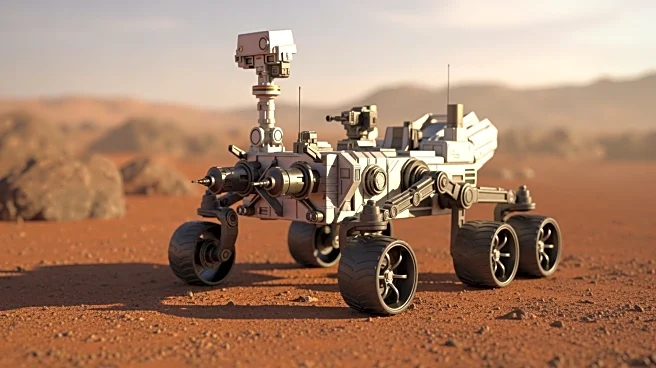

In 1997, NASA made history by landing the first rover on Mars, a small but mighty machine named Sojourner. Part of the Mars Pathfinder mission, Sojourner was a groundbreaking achievement in space exploration,
marking the first time a wheeled vehicle operated on a planet other than Earth or the Moon. This article explores the mission's objectives, the rover's design, and its significant contributions to our understanding of the Red Planet.
Mission Objectives and Achievements
The primary goal of the Mars Pathfinder mission was to demonstrate the feasibility of sending a rover to Mars using a cost-effective approach. The mission aimed to test new technologies and gather scientific data about the Martian environment. Sojourner was designed to operate for a minimum of seven sols (Martian days), but it far exceeded expectations by remaining active for 92 sols.
During its mission, Sojourner traveled over 100 meters, conducting various scientific experiments and sending back valuable data to Earth. It was equipped with front and rear cameras and an Alpha Proton X-ray Spectrometer (APXS) to analyze the chemical composition of Martian rocks and soil. The rover's findings provided crucial insights into the planet's geology and potential for past water activity.
Design and Technical Features
Sojourner was developed by NASA's Jet Propulsion Laboratory (JPL) and was a marvel of engineering. The rover measured 65 cm in length, 48 cm in width, and 30 cm in height, weighing just 10.6 kilograms. It featured six wheels, each powered by its own motor, allowing it to navigate the rocky Martian terrain with ease.
The rover's power system included solar panels and a non-rechargeable lithium-thionyl chloride battery, enabling it to operate during the day. Sojourner's communication with Earth was facilitated through the Pathfinder base station, which relayed data back to mission control. The rover's design and successful operation laid the groundwork for future Mars exploration missions.
Legacy and Impact
Sojourner's mission was a resounding success, proving that a small, cost-effective rover could perform valuable scientific work on Mars. The data collected by Sojourner helped scientists better understand the planet's surface and atmospheric conditions, paving the way for subsequent missions like the Mars Exploration Rovers Spirit and Opportunity.
The mission also demonstrated the effectiveness of the "faster, better, cheaper" approach to space exploration, influencing the design and execution of future missions. Sojourner's legacy lives on as a testament to human ingenuity and the relentless pursuit of knowledge about our solar system.
In conclusion, Sojourner's journey on Mars was a pivotal moment in space exploration history. Its achievements not only advanced our understanding of Mars but also inspired a new era of robotic exploration, setting the stage for more ambitious missions to the Red Planet.