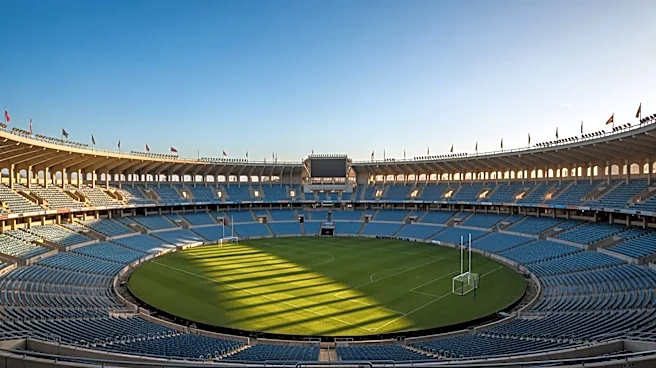






San Siro Stadium, officially known as Stadio Giuseppe Meazza, is a landmark in Milan, Italy, with a rich history that reflects its evolution over nearly a century. This iconic stadium has undergone numerous transformations since its inception, adapting to the changing needs of its tenants and the demands of international football.
Early Beginnings and Initial Construction
The idea to build a dedicated football stadium in Milan's San Siro district was conceived in the mid-1920s. Construction
began in 1925, spearheaded by the then-president of AC Milan, Piero Pirelli. The stadium was designed to be a private venue solely for football, a departure from the multi-purpose stadiums common in Italy at the time. This design was inspired by English football stadiums, featuring four separate stands without an athletics track.
The stadium was inaugurated on September 19, 1926, with a match between Inter and Milan, which Inter won 6-3. Initially, San Siro was the home ground of AC Milan, but it was later acquired by the City Council in the 1930s. This acquisition led to the first major expansion, connecting the existing stands to increase capacity.
Mid-Century Expansions and Renovations
From 1948 to 1955, the stadium underwent significant renovations to increase its capacity from 50,000 to 100,000. Engineers Armando Ronca and Ferruccio Calzolari designed a second tier of seating, supported by spiraling ramps that became a distinctive feature of the stadium. Although the original plan included a third tier, it was never completed due to safety concerns, and the capacity was eventually reduced to 60,000 seats.
In 1980, the stadium was renamed Stadio Giuseppe Meazza in honor of the legendary footballer who played for both Milan and Inter. This period also saw the stadium hosting several high-profile international matches, including games during the 1934 and 1990 FIFA World Cups.
Modernization and Future Prospects
The last major renovation occurred between 1987 and 1990, in preparation for the 1990 FIFA World Cup. This renovation included the addition of a third tier on three sides of the stadium and the installation of a new roof supported by red girders. These changes increased the capacity to 85,000 and modernized the stadium to meet international standards.
In recent years, discussions have emerged about replacing San Siro with a new stadium. Plans for a new 60,000-seat venue have been proposed, with construction expected to begin in the coming years. Despite these plans, San Siro remains a beloved icon in Milan, celebrated for its historical significance and architectural grandeur.