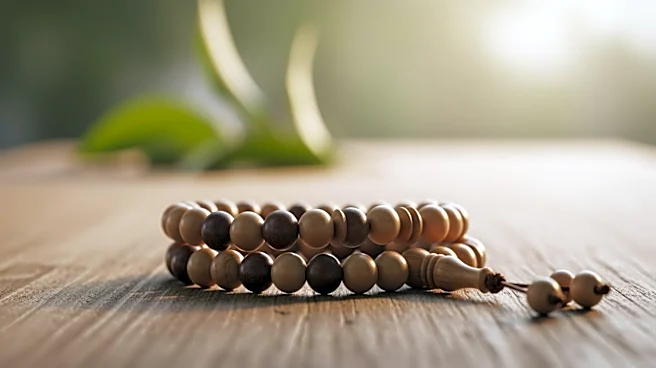

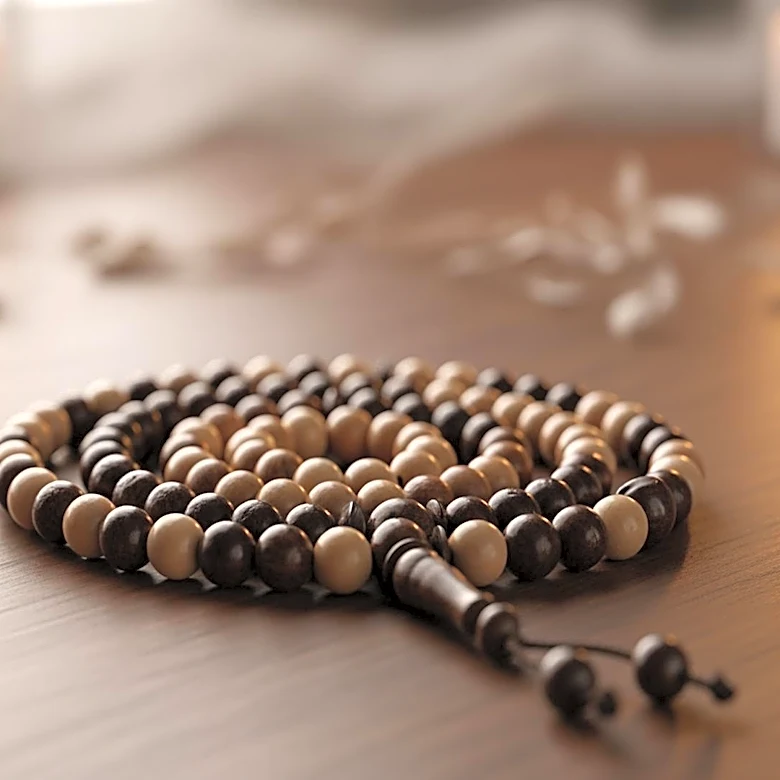




Prayer beads are more than just tools for counting prayers; they hold deep cultural and religious significance across various traditions. From Christianity to Buddhism, these beads serve as a physical representation of devotion and meditation. This article delves into the cultural importance of prayer beads, highlighting their role in different religious practices and the meanings they carry.
Historical Origins and Development
Prayer beads have a long history, with their origins tracing
back to ancient times. Beads are among the earliest human ornaments, with ostrich eggshell beads in Africa dating to 10,000 BC. Over the centuries, various cultures have crafted beads from materials like stone, shells, and clay. The concept of using beads for counting prayers can be linked to the Sumerian era, where primitive abacuses were used. The English word 'bead' itself descends from the Old English 'bede,' meaning 'prayer.'
The oldest image of prayer beads in a religious context is found in a fresco from the prehistoric settlement of Akrotiri, Santorini, Greece, dating from the 17th century BC. This practice was initially used in Hindu prayers and meditation in India, later adopted by Buddhism. As ancient Hindus migrated, the custom spread to various parts of the world, becoming integral to different religions.
Variations Across Religions
Different religions have unique forms of prayer beads, each with specific structures and purposes. In Christianity, the Catholic rosary consists of 59 beads, used to pray sequences of the Lord's Prayer, Hail Marys, and other prayers. The Anglican prayer beads, developed in the 1980s, consist of 33 beads representing the years of Jesus' life. Eastern Orthodox Christians use a knotted prayer rope called a komboskini, with 100 knots.
In Islam, prayer beads are known as misbaha or tasbih, typically possessing 99 beads corresponding to the names of God. Buddhists and Hindus use the Japa Mala, usually with 108 beads, while the Bahá'í Faith uses prayer beads with either 95 or 19 beads. Each set of beads serves a unique purpose, aiding in meditation and prayer.
Symbolic Meanings and Uses
Beyond their practical use, prayer beads carry symbolic meanings. They allow users to focus on their prayers, minimizing conscious effort in counting. In Judaism, while prayer beads are not traditionally used, some individual Jews use them for personal reasons, provided they do not bear symbols of other religions.
In Christianity, the rosary is seen as a spiritual sword, a tool for meditation and contemplation. The beads symbolize participation in the life of Mary, whose focus was Christ. In Islam, the misbaha is used for dhikr, repetitive utterances to praise and glorify God. Across all these traditions, prayer beads serve as a tangible connection to the divine, enhancing spiritual practices and devotion.