


Io, one of Jupiter's moons, stands out in the solar system for its extraordinary volcanic activity. Unlike any other celestial body, Io's surface is constantly reshaped by its numerous active volcanoes. This article delves into the causes and characteristics of Io's volcanism, exploring how this small moon became a world of fire.
The Mechanism Behind Io's Volcanism
The intense volcanic activity on Io is primarily driven by tidal heating. Io's orbit around Jupiter is slightly elliptical,
causing varying gravitational forces as it moves closer and farther from the planet. This gravitational tug-of-war, combined with interactions with other Galilean moons, generates significant internal friction and heat within Io.
This heat keeps Io's interior in a molten state, providing a continuous supply of magma to its surface. Unlike Earth, where volcanic activity is driven by plate tectonics and radioactive decay, Io's volcanism is a direct result of these tidal forces. This unique mechanism makes Io the most volcanically active body in the solar system, with eruptions occurring frequently across its surface.
The Spectacular Eruptions of Io
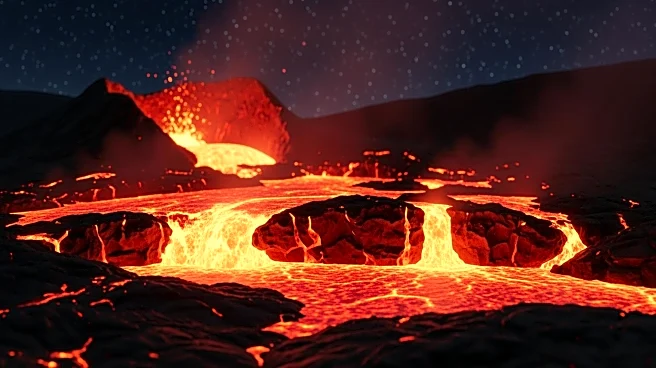
Io's volcanoes are known for their dramatic eruptions, which can be seen from space. These eruptions often produce towering plumes of sulfur and sulfur dioxide, reaching heights of up to 500 kilometers. The material ejected from these plumes settles back onto the surface, creating colorful deposits that give Io its distinctive appearance.
The lava flows on Io are primarily composed of basalt, similar to those found on Earth. However, some eruptions have been observed with temperatures exceeding 1,600 Kelvin, suggesting the presence of ultramafic lavas. These high-temperature eruptions contribute to the rapid resurfacing of Io, erasing impact craters and maintaining its youthful appearance.
Io's Volcanism and Its Impact on Jupiter
The volcanic activity on Io has a significant impact on its environment and Jupiter's magnetosphere. The material ejected from Io's volcanoes forms a thin atmosphere around the moon, primarily composed of sulfur dioxide. This atmosphere is constantly replenished by volcanic eruptions, as Io lacks the gravity to retain it for long periods.
Additionally, the volcanic plumes contribute to a torus of plasma around Jupiter, created as the ejected material becomes ionized and trapped by the planet's magnetic field. This interaction between Io's volcanism and Jupiter's magnetosphere is a subject of ongoing study, providing insights into the complex dynamics of the Jovian system.