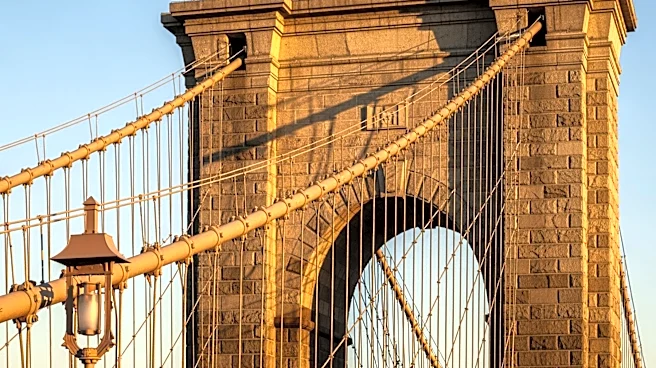







The Brooklyn Bridge stands as a testament to human ingenuity and perseverance. Connecting Manhattan and Brooklyn, this iconic suspension bridge has been a major landmark in New York City since its opening in 1883. Designed by John Roebling and completed by his son Washington Roebling, the bridge is not only a feat of engineering but also a symbol of the city's growth and development.
The Vision of John Roebling
John Roebling, a German immigrant and a pioneering engineer, envisioned
the Brooklyn Bridge as a solution to the growing transportation needs between Manhattan and Brooklyn. At the time, the East River posed a significant barrier to commerce and travel. Roebling's design for a suspension bridge was revolutionary, promising to connect the two boroughs with a structure that could withstand the river's challenges.
Roebling's plans included the use of steel cables, a novel idea that would provide the necessary strength and flexibility for the bridge. Unfortunately, Roebling did not live to see his vision realized. He died in 1869 from tetanus, following an accident at the bridge site. His son, Washington Roebling, took over as chief engineer, determined to bring his father's dream to fruition.
Washington Roebling's Challenges
Washington Roebling faced numerous challenges during the construction of the Brooklyn Bridge. One of the most significant was his battle with decompression sickness, known at the time as "caisson disease." This condition, caused by working in the pressurized underwater caissons, left him bedridden for much of the construction period.
Despite his illness, Washington Roebling continued to oversee the project with the help of his wife, Emily Warren Roebling. Emily became an essential liaison between her husband and the construction team, learning about engineering and construction to effectively communicate Washington's instructions. Her dedication and intelligence were crucial in ensuring the bridge's completion.
The Bridge's Legacy
The Brooklyn Bridge was completed in 1883, marking a new era in urban transportation and engineering. It was the longest suspension bridge in the world at the time, and its completion was celebrated with great fanfare. Emily Roebling was the first to cross the bridge, carrying a rooster as a symbol of victory.
Today, the Brooklyn Bridge remains a beloved symbol of New York City. It represents not only a physical connection between two boroughs but also the spirit of innovation and determination. The bridge's history is a reminder of the challenges overcome by the Roebling family and the lasting impact of their work on the city's landscape.