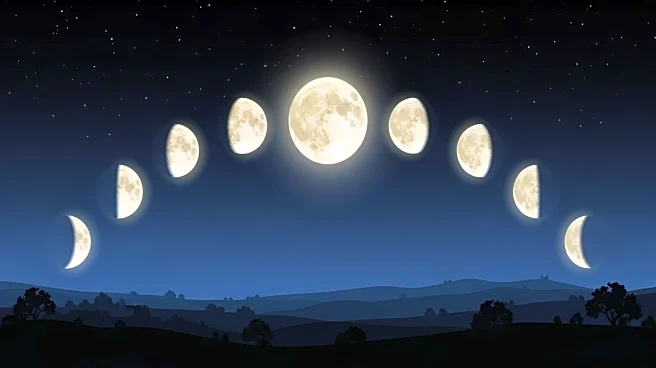



The Moon has fascinated humans for centuries, with its changing phases sparking curiosity and wonder. The lunar phases, or the apparent shape of the Moon as seen from Earth, have been observed and studied throughout history. This article delves into the historical development of our understanding of lunar phases, highlighting key milestones and the evolution of this knowledge over time.
Early Observations and Theories
In ancient times, people observed the Moon's changing appearance
and sought to understand its patterns. Early civilizations, such as the Babylonians and Greeks, made significant contributions to the study of lunar phases. They noted the regular cycle of the Moon's phases and attempted to explain these changes through various theories. The Greeks, for instance, proposed that the Moon's phases were caused by its position relative to the Earth and Sun.
The concept of a lunar month, the time between successive recurrences of the same phase, was also developed during this period. Ancient astronomers recognized that the lunar month was not perfectly constant, averaging about 29.5 days. This understanding laid the groundwork for future studies and the development of more accurate lunar calendars.
Advancements in the Middle Ages
During the Middle Ages, the study of lunar phases continued to evolve. Islamic astronomers made significant advancements in understanding the Moon's motion and its phases. They developed more precise methods for calculating the lunar month and improved the accuracy of lunar calendars. These contributions were crucial in refining the knowledge of lunar phases and their impact on timekeeping.
In Europe, the Renaissance period saw a renewed interest in astronomy, leading to further advancements in the study of lunar phases. The invention of the telescope allowed astronomers to observe the Moon in greater detail, providing new insights into its surface and phases. This period marked a significant turning point in the understanding of lunar phases, as observations became more precise and theories more refined.
Modern Understanding and Misconceptions
In modern times, the study of lunar phases has become more sophisticated, with advancements in technology and space exploration. The Moon's phases are now understood as a result of its orbit around the Earth and the Earth's orbit around the Sun. This understanding has been further enhanced by space missions that have provided detailed images and data about the Moon's surface and its phases.
Despite this progress, misconceptions about lunar phases persist. For example, some people mistakenly believe that the "dark side" of the Moon is always unlit, when in fact, both sides receive equal amounts of sunlight over time. Additionally, the difference between the Moon's orbital period and the synodic period can be confusing, leading to misunderstandings about the timing of lunar phases.
Overall, the journey to understanding lunar phases has been a long and fascinating one, marked by significant milestones and ongoing curiosity. As our knowledge continues to grow, the Moon remains a source of wonder and inspiration for future generations.