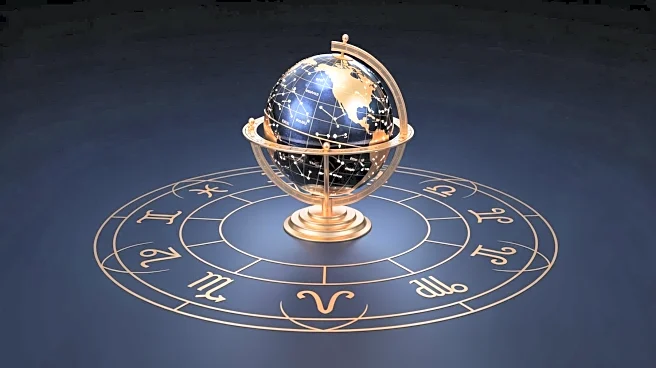



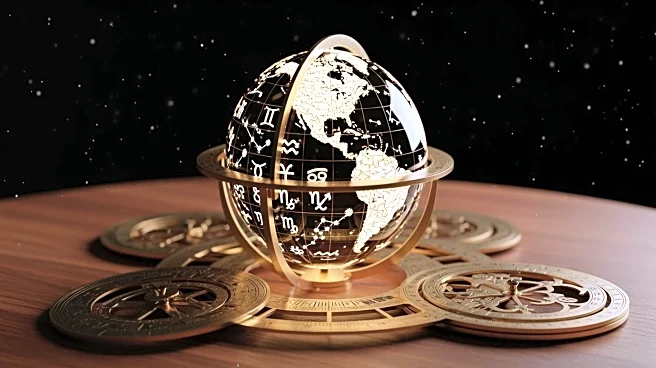
Astrology, often regarded as a pseudoscience, is a complex system that interprets celestial movements to predict human affairs. This article delves into the foundational principles and diverse practices of astrology, highlighting its symbolic language and the various systems that have developed across cultures.
The Symbolic Language of Astrology
Astrology is often described as a symbolic language, an art form, and a method of divination. It is based on the belief that the positions
and movements of celestial bodies can provide insights into human affairs and terrestrial events. The horoscope, a map of the heavens at a specific moment, is central to astrological practice. It visually expresses the relationships between planets, zodiac signs, and houses, forming what is described as "the language of the heavens."
In Western astrology, the horoscope is constructed for an exact moment, such as a person's birth, using the tropical zodiac aligned to the equinoctial points. The relationships between planets, their aspects, and their placement in houses are analyzed to interpret personality traits and predict life events. This system has influenced various belief systems, including Western esotericism and Wicca.
Diverse Astrological Traditions
While Western astrology is one of the most well-known systems, many cultures have developed their own astrological traditions. Hindu astrology, also known as Vedic astrology, incorporates the Hindu lunar mansions and has its roots in Hellenistic astrology. It emphasizes the influence of the lunar nodes and retrograde planets, reflecting its unique cultural context.
Chinese astrology, on the other hand, is closely related to Chinese philosophy and uses concepts such as yin and yang, the Five phases, and the Chinese zodiac. The Chinese zodiac, based on cycles of years, lunar months, and two-hour periods of the day, assigns animal signs to represent different personality types. This system is still widely used in modern-day China and other East Asian cultures.
Astrology's Modern Representation
In contemporary times, astrology is often reduced to Sun sign astrology in popular media, focusing solely on the zodiac sign of the Sun at an individual's birth. However, this represents only a fraction of the total astrological chart. Despite its simplification, astrology remains popular, with many people turning to it for guidance and self-reflection.
Astrology's principles and practices have evolved over millennia, adapting to different cultural contexts and philosophical frameworks. While it may lack scientific validation, its symbolic language and diverse traditions continue to captivate people worldwide, offering insights into human nature and the cosmos.
The enduring appeal of astrology lies in its ability to provide a sense of connection to the universe and a framework for understanding the complexities of life.