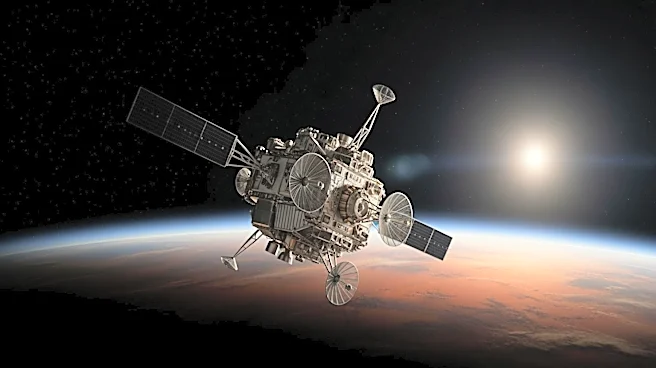







Mariner 9 was not just a milestone in space exploration for being the first spacecraft to orbit another planet; it was also a technological marvel of its time. The spacecraft was equipped with advanced instruments and systems that allowed it to conduct a comprehensive study of Mars. This article delves into the technological innovations that made Mariner 9 a standout mission in the history of space exploration.
Power and Propulsion Systems
The power system of Mariner 9 was a feat
of engineering. The spacecraft was equipped with 14,742 solar cells distributed across four solar panels, providing a total of 500 watts of power while in Mars orbit. This energy was stored in a 20 amp-hour nickel-cadmium battery, ensuring that the spacecraft could operate efficiently even when not in direct sunlight.
For propulsion, Mariner 9 used the RS-2101a engine, capable of producing 1340 N thrust. This engine could be restarted up to five times, allowing for precise control of the spacecraft's orbit around Mars. The propulsion system was complemented by attitude control mechanisms, including nitrogen jets and a suite of sensors such as a Sun sensor and a Canopus star tracker, which helped maintain the spacecraft's orientation.
Scientific Instruments and Experiments
Mariner 9 was equipped with a range of scientific instruments designed to study Mars's atmosphere and surface. The Ultraviolet Spectrometer (UVS) analyzed the composition and density of the Martian upper atmosphere, detecting elements like hydrogen, oxygen, and ozone. This instrument provided valuable data on the escape rates of these elements, influencing our understanding of Mars's atmospheric evolution.
The Infrared Interferometer Spectrometer (IRIS) measured thermal radiation from Mars, analyzing atmospheric composition, surface temperature, and dust properties. It confirmed the presence of carbon dioxide as the dominant atmospheric gas and detected water vapor in the Martian atmosphere. These findings were crucial in shaping our understanding of Mars's climate and geological history.
Imaging and Legacy
One of the most significant technological advancements of Mariner 9 was its Visual Imaging System, which captured high-resolution images of Mars's surface and its moons. The system employed two vidicon television cameras, achieving a resolution of 98 meters per pixel, a significant improvement over previous missions.
The images captured by Mariner 9 revealed a wealth of information about Mars, including its volcanoes, valleys, and evidence of past water activity. These discoveries laid the foundation for future Mars exploration missions and demonstrated the importance of advanced imaging technology in planetary science. Mariner 9's technological innovations continue to inspire and inform the design of modern spacecraft, cementing its legacy as a pioneer in space exploration.