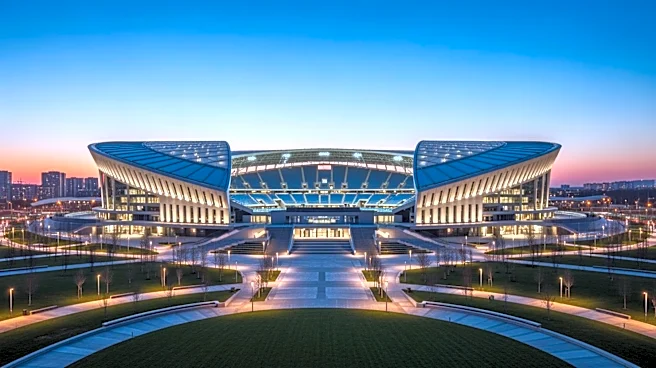







Jeonju World Cup Stadium stands as a significant landmark in Jeonju, South Korea, with a rich history tied to the 2002 FIFA World Cup. Constructed specifically for the event, the stadium has played a crucial role in both local and international football. Its development marked a new era for sports infrastructure in South Korea, reflecting the country's ambitions on the global stage.
Construction and Development
The construction of Jeonju World Cup Stadium began in February 1999,
as part of South Korea's preparations to co-host the 2002 FIFA World Cup with Japan. The project was a massive undertaking, aimed at creating a venue that could accommodate the demands of a world-class sporting event. The stadium was officially opened on November 8, 2001, by South Korean President Kim Dae-jung, signaling the completion of a key component in the country's World Cup infrastructure.
The design of the stadium was focused on providing an optimal experience for both players and spectators. With a seating capacity of 34,207, it was equipped to handle large crowds and ensure a vibrant atmosphere during matches. The construction of the stadium was part of a broader initiative to enhance South Korea's sporting facilities, positioning the country as a capable host for international events.
Role in the 2002 FIFA World Cup
Jeonju World Cup Stadium was one of the venues for the 2002 FIFA World Cup, hosting three matches during the tournament. The first match took place on June 7, 2002, between Spain and Paraguay, with Spain winning 3-1. This match was part of Group B and showcased the stadium's ability to host high-profile international games.
The second match, held on June 10, 2002, saw Portugal face Poland in a Group D encounter. Portugal emerged victorious with a 4-0 scoreline, further highlighting the stadium's role in the World Cup. The final match hosted at Jeonju was a round of 16 clash between Mexico and the United States on June 17, 2002, with the United States winning 2-0.
Legacy and Current Use
Since the 2002 FIFA World Cup, Jeonju World Cup Stadium has continued to serve as a prominent venue for football in South Korea. It is the home of Jeonbuk Hyundai Motors, a testament to its ongoing relevance in the country's sporting landscape. The stadium's involvement in the World Cup left a lasting legacy, contributing to Jeonju's reputation as a city capable of hosting major international events.
The stadium remains a symbol of South Korea's commitment to sports and its ability to execute large-scale projects. Its history is a reflection of the country's growth in the global sporting community, and it continues to be a focal point for football fans and players alike.