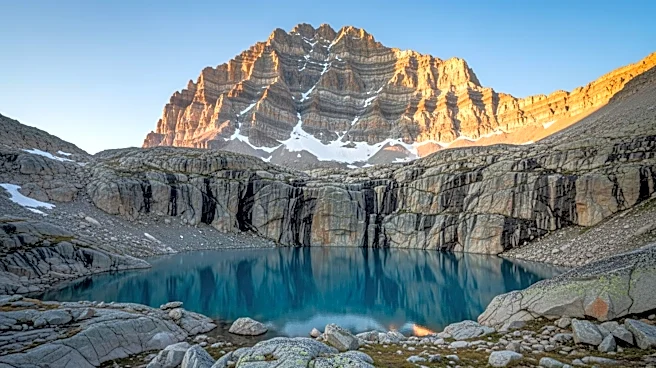








Glacier National Park, located in northwestern Montana, is a geological marvel that offers a glimpse into the Earth's ancient past. The park's dramatic landscapes were shaped by massive glaciers and tectonic forces over millions of years. This article delves into the park's geological history, the unique rock formations, and the evidence of glacial activity that defines its stunning terrain.
The Formation of the Park's Mountains
The mountains of Glacier National Park began forming around
170 million years ago during a period of significant geological upheaval. This process, known as the Lewis Overthrust, involved ancient sedimentary rocks being pushed eastward over much younger rock strata. The result is a fascinating geological anomaly where older rocks rest atop newer ones, providing some of the finest examples of early life fossils on Earth. These sedimentary rocks, part of the Belt Supergroup, were deposited in shallow seas over 1.6 billion to 800 million years ago, preserving a rich record of early life.
The park's highest peaks, including Mount Cleveland, rise over 10,000 feet and showcase the dramatic effects of this overthrust. Chief Mountain, an isolated peak on the park's eastern boundary, stands as a testament to these powerful geological forces, rising 2,500 feet above the Great Plains.
Evidence of Glacial Activity
Glacier National Park's landscape is a testament to the power of glaciers. The park's current topography was largely shaped by the massive glaciers of the last ice age, which have since retreated over the past 12,000 years. Evidence of this glacial activity is visible throughout the park in the form of U-shaped valleys, cirques, arêtes, and large outflow lakes that radiate from the base of the highest peaks.
The park's glaciers have been retreating since the end of the Little Ice Age around 1850. At that time, there were approximately 150 glaciers over 25 acres in size. By 2010, only 25 active glaciers remained, and scientists estimate that all may disappear by 2030 if current climate patterns persist.
The Park's Unique Geological Features
The rocks in Glacier National Park are among the best-preserved Proterozoic sedimentary rocks in the world. They contain features such as ripple marks, mud cracks, and fossilized stromatolites, which are early organisms consisting primarily of blue-green algae. These rocks provide a window into the Earth's distant past, offering insights into the conditions that existed over a billion years ago.
Triple Divide Peak is another geological highlight of the park. It is the apex of the North American continent, where waters flow toward the Pacific Ocean, Hudson Bay, and the Gulf of Mexico. This unique feature underscores the park's significance as a geological and hydrological landmark.
Glacier National Park's geological history is a story of ancient seas, tectonic forces, and glacial sculpting. Its landscapes offer a breathtaking view of the Earth's dynamic processes, making it a must-visit destination for geology enthusiasts and nature lovers alike.