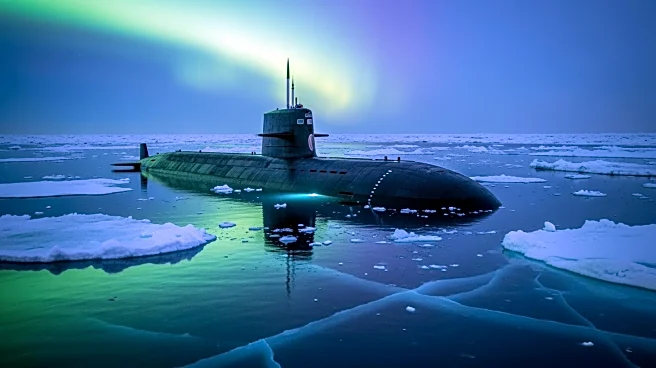

The USS Nautilus (SSN-571) made history on August 3, 1958, by becoming the first submarine to complete a submerged transit of the North Pole. This remarkable achievement was part of Operation Sunshine,
a mission ordered by President Eisenhower to demonstrate American technological capabilities following the Soviet Union's successful launch of Sputnik. The Nautilus's journey under the Arctic ice cap marked a significant milestone in naval exploration and showcased the potential of nuclear-powered submarines.
Operation Sunshine: A Technological Showcase
Operation Sunshine was initiated as a response to the Soviet Union's advancements in space technology. President Eisenhower ordered the U.S. Navy to attempt a submarine transit of the North Pole as a technological showpiece. The USS Nautilus, under the command of Commander William R. Anderson, embarked on this historic mission, leaving Seattle on June 9, 1958.
The Nautilus faced challenges during its initial attempt to navigate the Chukchi Sea, where deep drift ice in shallow waters forced the submarine to turn back. After waiting for better ice conditions, the Nautilus set a course northward on July 23, 1958. It submerged in the Barrow Sea Valley on August 1 and reached the geographic North Pole on August 3, becoming the first watercraft to achieve this feat.
Navigating the Arctic Ice Cap
The journey beneath the Arctic ice cap presented unique navigation challenges. Both magnetic compasses and normal gyrocompasses became inaccurate above 85°N, necessitating the use of a special gyrocompass built by Sperry Rand. The Nautilus's ability to navigate at extreme latitudes without surfacing was enabled by the North American Aviation N6A-1 Inertial Navigation System, a naval modification of the N6A used in the Navaho cruise missile.
The most difficult part of the journey was navigating the Bering Strait, where ice extended as much as 60 feet below sea level. The Nautilus successfully passed through a known channel close to Alaska during its second attempt, allowing it to continue its historic voyage.
Legacy of the North Pole Transit
The successful transit of the North Pole by the USS Nautilus opened the possibility of a new commercial seaway, a Northwest Passage, between the major oceans of the world. The voyage demonstrated the capabilities of nuclear-powered submarines and their potential for future exploration and trade.
The Nautilus's historic journey remains a testament to the pioneering spirit of naval exploration and the advancements in submarine technology. As a National Historic Landmark, the Nautilus continues to inspire visitors at the Submarine Force Library and Museum in Groton, Connecticut, preserving the legacy of its groundbreaking achievements.