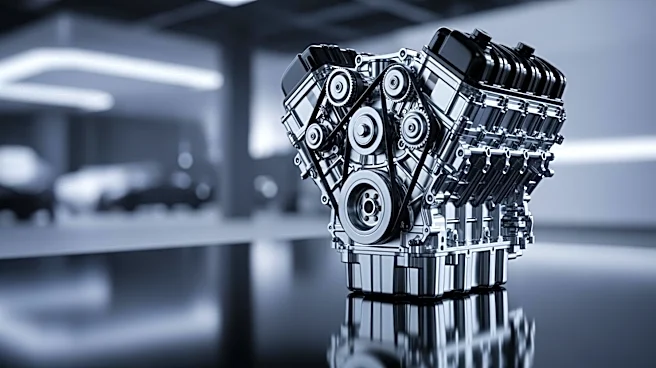



The Alfa Romeo Boxer engine, a water-cooled flat-four piston engine, has a rich history that spans over two decades. Known for its unique design and application in front-wheel-drive vehicles, this engine was a staple in Alfa Romeo's lineup until it was replaced in the late 1990s. This article explores the development and evolution of the Alfa Romeo Boxer engine, highlighting its key features and the changes it underwent over the years.
Introduction and Early Development
The Alfa Romeo
Boxer engine made its debut in 1971 at the Turin Motor Show, powering the Alfasud. This engine was developed specifically for front-wheel-drive and longitudinal applications, setting it apart from other engines of its time. The Boxer engine's design featured a flat-four configuration, which allowed for a lower center of gravity and improved balance, making it ideal for the sporty and agile Alfasud.
Throughout the 1970s, the Boxer engine underwent several upgrades to enhance its performance and efficiency. The engine's displacement varied from 1.2 liters to 1.7 liters, with each version offering different power outputs to cater to a range of driving needs. The engine's construction included a cast iron cylinder block and aluminum alloy cylinder heads, which contributed to its durability and performance.
Technological Advancements and Variants
As the years progressed, the Alfa Romeo Boxer engine saw significant technological advancements. The introduction of fuel injection systems, such as the Bosch LE 3.1 Jetronic and Bosch Motronic ML 4.1, marked a shift from carburetors to more efficient fuel delivery methods. These advancements not only improved the engine's performance but also helped meet stricter emissions standards.
The Boxer engine was available in various configurations, including single and double overhead camshaft designs, with two or four valves per cylinder. The most powerful variant, the 1700 16V, featured a quad-cam 16-valve setup, producing up to 137 PS. This version was exclusively available with fuel injection, showcasing Alfa Romeo's commitment to innovation and performance.
The End of an Era
By the mid-1990s, the Alfa Romeo Boxer engine had powered numerous models, becoming a defining feature of the brand's front-wheel-drive lineup. However, as automotive technology continued to evolve, the Boxer engine was gradually phased out. In 1997, it was replaced by the transversely-mounted Twin Spark engines, which offered improved efficiency and performance.
The transition marked the end of an era for the Alfa Romeo Boxer engine, but its legacy lives on in the models it powered and the innovations it introduced. The Boxer engine remains a testament to Alfa Romeo's engineering prowess and its ability to adapt to changing automotive landscapes.