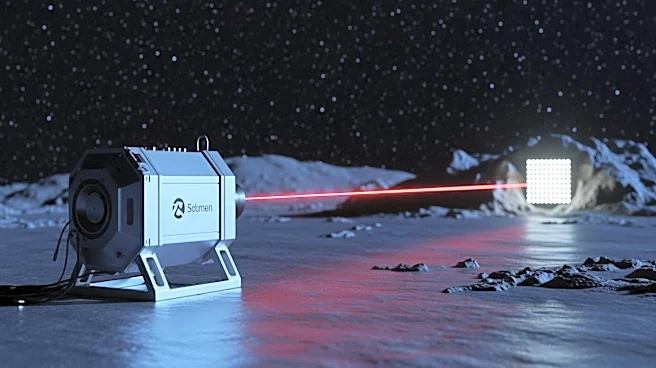






Lunar laser ranging has come a long way since its inception in the early 1960s. With technological advancements and improved methodologies, modern lunar laser ranging experiments have achieved unprecedented levels of precision. These advancements have not only enhanced our understanding of the Earth-Moon system but have also provided valuable insights into fundamental physics and gravitational theories.
Technological Innovations
One of the most significant advancements in lunar
laser ranging is the development of more powerful and precise laser systems. Early experiments relied on lasers with limited power and precision, resulting in less accurate measurements. However, modern systems, such as those used in the Apache Point Observatory Lunar Laser-ranging Operation (APOLLO), utilize advanced laser technology to achieve millimeter-level accuracy.
The APOLLO project, based in New Mexico, represents a significant leap forward in lunar laser ranging capabilities. By using a large telescope and a site with excellent atmospheric conditions, APOLLO has been able to record stronger reflections and more accurate measurements than previous facilities. This has allowed scientists to test various aspects of gravitational theories with greater precision.
Enhanced Measurement Techniques
In addition to technological innovations, modern lunar laser ranging experiments have benefited from improved measurement techniques. The use of retroreflectors, installed on the lunar surface by the Apollo missions and Soviet Lunokhod rovers, has been instrumental in enhancing measurement precision. These devices reflect laser beams directly back to Earth, allowing for more accurate calculations of the lunar distance.
The precision of these measurements has been further improved by advancements in data analysis and modeling. Scientists now consider a wide range of factors, including the relative motion of the Earth and Moon, Earth's rotation, and atmospheric conditions, to ensure the accuracy of their calculations. This comprehensive approach has led to a deeper understanding of the dynamics of the Earth-Moon system.
Implications for Scientific Research
The advancements in lunar laser ranging have significant implications for scientific research. The precise measurements obtained from these experiments have been used to test various aspects of gravitational theories, including general relativity. They have also contributed to our understanding of lunar motion, Earth's rotation, and even the potential variation of the gravitational constant over time.
Furthermore, the data collected from modern lunar laser ranging experiments have provided valuable insights into the structure and composition of the Moon. By analyzing the reflected laser signals, scientists can infer information about the lunar surface and its physical properties.
Overall, the modern advances in lunar laser ranging represent a remarkable achievement in scientific research. These advancements continue to push the boundaries of our understanding of the universe, demonstrating the enduring importance of lunar laser ranging in the field of astronomy.