
Astrology and astronomy, once intertwined disciplines, have taken vastly different paths over the centuries. While astrology is now considered a pseudoscience, astronomy has evolved into a respected scientific
field. This divergence began in the 18th century when astrology lost its scholarly status, and astronomy became a physical science supported by empirical evidence. Understanding this historical separation provides insight into how these fields have shaped human understanding of the cosmos.
The Shared Origins
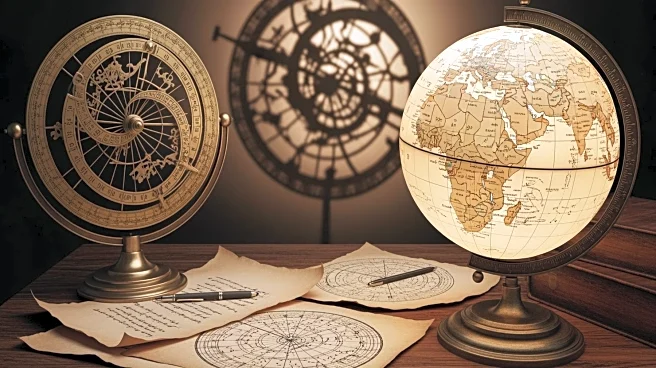
Astrology and astronomy share a common origin, with both disciplines emerging from ancient civilizations' fascination with the sky. Early humans used celestial observations to predict seasonal changes and interpret divine communications. These practices laid the groundwork for both astrology and astronomy. Ancient cultures, including the Babylonians, Greeks, and Egyptians, developed sophisticated systems to study celestial cycles, which influenced both fields.
In the ancient world, astrology was considered a scholarly tradition, closely linked with astronomy, meteorology, medicine, and alchemy. It was widely accepted in political and academic circles, with notable figures like Tycho Brahe and Johannes Kepler practicing astrology alongside their astronomical pursuits. However, as scientific methods advanced, astrology's lack of empirical support led to its decline as a legitimate scholarly pursuit.
The Enlightenment and Scientific Method
The Enlightenment marked a turning point in the separation of astrology and astronomy. During this period, the scientific method gained prominence, challenging astrology's theoretical and experimental validity. Researchers demonstrated that astrology lacked scientific explanatory power, leading to its classification as a pseudoscience. Astronomy, on the other hand, embraced the scientific method, focusing on empirical observations and mathematical models to study celestial objects.
This shift was further reinforced by the work of astronomers like Galileo Galilei and Isaac Newton, who provided evidence for the heliocentric model and formulated laws of motion and gravitation. These advancements solidified astronomy's status as a physical science, distinct from astrology's divinatory practices.
Modern Perspectives
Today, astrology and astronomy are recognized as separate fields, with astronomy being a respected scientific discipline and astrology considered a pseudoscience. Astronomy continues to explore the universe through rigorous scientific inquiry, while astrology remains popular in cultural and spiritual contexts. Despite their divergence, both fields continue to captivate human imagination and curiosity about the cosmos.
The historical separation of astrology and astronomy highlights the evolution of human understanding of the universe. While astrology's influence has waned in scientific circles, its cultural impact persists. Astronomy, supported by empirical evidence, continues to expand our knowledge of the cosmos, demonstrating the power of scientific inquiry.