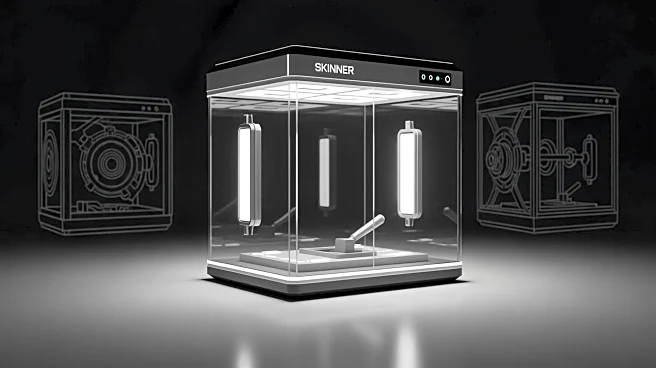




Operant conditioning is a fundamental concept in behavioral psychology, and the operant conditioning chamber, often referred to as the Skinner box, plays a crucial role in its study. Developed by B.F. Skinner, this apparatus has been instrumental in understanding animal behavior and the principles of operant conditioning. This article delves into the historical development of the operant conditioning chamber and its purpose in behavioral research.
The Birth of the Skinner Box
The operant conditioning chamber was created by B.F. Skinner while he was a graduate student at Harvard University. Skinner's invention was a variation of the puzzle box originally designed by Edward Thorndike. Thorndike's work involved cats learning to escape from boxes by performing specific actions, which laid the groundwork for Skinner's later developments. Skinner's chamber allowed for more controlled and precise observation of animal behavior, which was essential for testing specific hypotheses in a laboratory setting.
Initially, Skinner's studies focused on rats, but he later expanded his research to include pigeons. The chamber was designed to observe and manipulate behavior by teaching animals to perform certain actions, such as pressing a lever, in response to specific stimuli. When the correct action was performed, the animal received positive reinforcement, such as food, or the removal of an unpleasant stimulus, like a loud noise.
Structure and Functionality
The operant conditioning chamber is a large box that can accommodate various animals, including rodents, pigeons, and primates. It is often sound-proof and light-proof to minimize distractions. The chamber includes at least one response mechanism, such as a lever or a series of lights, which the animal interacts with in response to stimuli. For example, a rat might press a lever to receive a food reward, while a pigeon might peck at a key to achieve the same result.
Modern operant conditioning chambers may have multiple mechanisms, such as several levers, feeders, and devices capable of generating different stimuli, including lights and sounds. Some chambers even have electrified floors to deliver shocks as a form of positive punishment. These features allow researchers to study a wide range of psychological phenomena in a controlled environment.
Impact on Behavioral Research
The operant conditioning chamber has become a staple in behavioral research, particularly in the study of animal learning. Its design allows for easy monitoring and manipulation of animal behavior, providing insights that are difficult to obtain in natural settings. Skinner's work with the chamber laid the foundation for similar studies on human subjects, influencing developmental psychology and education.
Skinner's theory of operant conditioning has helped psychologists understand how behavior is learned and how reinforcement can be used effectively in the learning process. The operant conditioning chamber remains a vital tool in exploring the complexities of behavior and the principles that govern it.