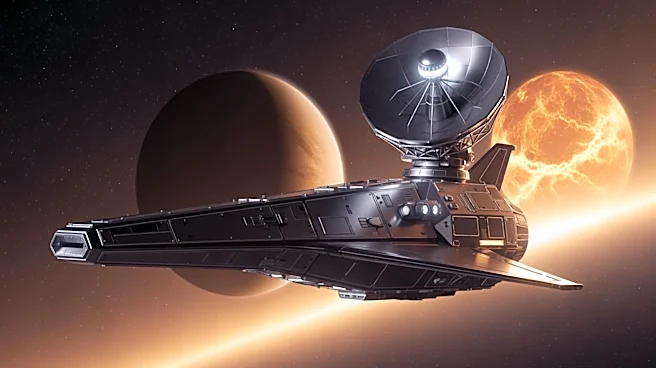

The Magellan spacecraft, launched by NASA in 1989, marked a significant milestone in space exploration. Designed to map the surface of Venus, Magellan was the first interplanetary mission launched from
the Space Shuttle. This article delves into the historical timeline and mission objectives of the Magellan spacecraft, highlighting its contributions to our understanding of Venus.
The Birth of Magellan
The idea for a radar mapping mission to Venus began in the late 1970s. Scientists initially proposed the Venus Orbiting Imaging Radar (VOIR) mission, but budget constraints led to its cancellation in 1982. A simplified radar mission was later recommended and accepted as the Venus Radar Mapper program in 1983. In 1985, the mission was renamed Magellan, honoring the Portuguese explorer Ferdinand Magellan.
The spacecraft was designed and built by the Martin Marietta Company, with the Jet Propulsion Laboratory (JPL) managing the mission for NASA. The spacecraft's synthetic aperture radar was developed by Hughes Aircraft Company's Space and Communications Group. To save costs, Magellan was constructed using flight spare parts and reused design elements from other spacecraft.
Launch and Trajectory
Magellan was launched on May 4, 1989, aboard Space Shuttle Atlantis during mission STS-30. Once in orbit, the spacecraft and its attached Inertial Upper Stage booster were deployed, sending Magellan into a heliocentric orbit. Originally scheduled for launch in 1988, the mission was delayed due to the Space Shuttle Challenger disaster in 1986.
The spacecraft's trajectory involved circling the Sun 1.5 times before reaching Venus on August 10, 1990. This extended journey was necessary due to the cancellation of the Centaur G upper-stage booster program, which required modifications to the Magellan probe.
Mission Objectives and Achievements
Magellan's primary mission was to obtain near-global radar images of Venus with a resolution equivalent to optical imaging. The spacecraft aimed to develop a topographic map and gather gravity field data to understand the geological structure of Venus.
During its mission, Magellan created the first high-resolution mapping of Venus's surface features, providing detailed imaging and analysis of craters, hills, ridges, and other geologic formations. The spacecraft employed aerobraking techniques to lower its orbit, marking the first prolonged use of this method.
Magellan's mission concluded in 1994 when it was deliberately crashed into Venus. The data collected by Magellan has significantly enhanced our understanding of Venusian geology and the planet's surface structures.