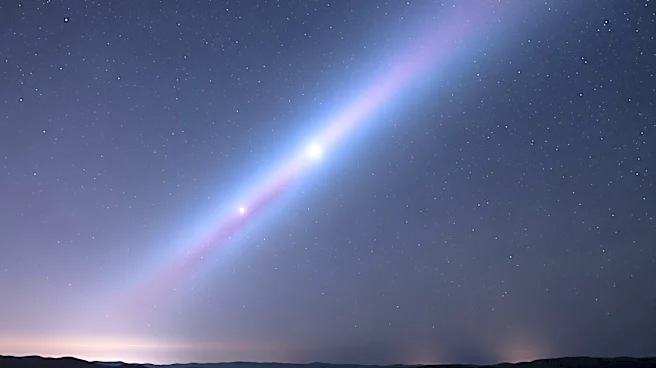



Zodiacal light is a fascinating celestial phenomenon that has intrigued astronomers and sky watchers for centuries. This faint glow, visible in the night sky, is caused by sunlight reflecting off interplanetary dust particles. It appears as a diffuse, triangular light extending from the horizon along the ecliptic, often visible just after sunset or before sunrise. Despite its faintness, zodiacal light contributes to the natural illumination of the night sky, offering
a glimpse into the vastness of our solar system.
The Science Behind Zodiacal Light
Zodiacal light is produced by sunlight scattering off tiny dust particles in the solar system, known as cosmic dust. These particles form a thick, pancake-shaped cloud called the zodiacal cloud, which straddles the ecliptic plane. The dust particles range in size from 10 to 300 micrometers, with masses from one nanogram to tens of micrograms. The light we see is essentially sunlight reflecting off these particles, giving zodiacal light the same spectrum as the solar spectrum.The interplanetary dust cloud is centered on the Sun and extends well beyond Earth's orbit. Most of the dust is located near the plane of the solar system, which is why zodiacal light is observed along the ecliptic. The amount of material needed to produce the observed zodiacal light is surprisingly small. If the dust were in the form of 1 mm particles, each would be about 8 km from its neighbors.
Observing Zodiacal Light
Zodiacal light is best observed in the mid-latitudes during spring and autumn. In spring, it is visible in the western sky after evening twilight, while in autumn, it appears in the eastern sky before morning twilight. The light forms a column, brighter at the horizon and tilted at the angle of the ecliptic. It is most visible near sunrise or sunset when the Sun is blocked, but the dust particles nearest the line of sight to the Sun are not.The phenomenon is often outshone by moonlight or light pollution, making it challenging to observe in urban areas. However, in a particularly dark night sky, zodiacal light can span the entire sky, contributing to the natural light of a clear and moonless night.
The Role of Interplanetary Dust
The source of the interplanetary dust has been debated for years. It was initially thought to originate from the tails of active comets and collisions between asteroids. Recent studies suggest that over 85 percent of the dust comes from occasional fragmentations of Jupiter-family comets. These comets have orbital periods of less than 20 years and are considered dormant when not actively outgassing.The Poynting–Robertson effect forces the dust into more circular orbits while spiraling slowly into the Sun. This necessitates a continuous source of new particles to maintain the zodiacal cloud. Cometary dust and dust generated by asteroid collisions are believed to be primarily responsible for sustaining the dust cloud that produces zodiacal light and gegenschein, a related phenomenon.