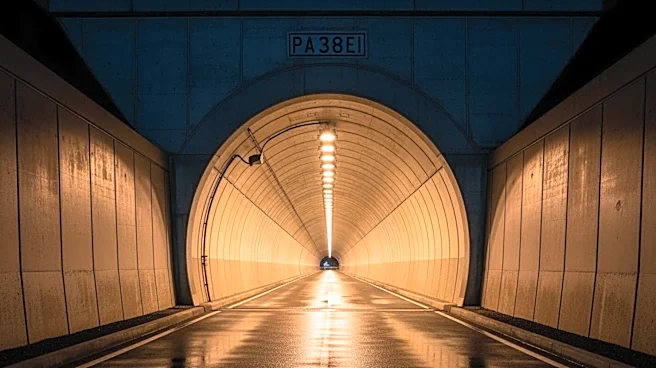

The Brooklyn–Battery Tunnel, officially known as the Hugh L. Carey Tunnel, stands as a monumental feat of engineering in New York City. Connecting Red Hook in Brooklyn with the Battery in Manhattan, this
tunnel is the longest continuous underwater vehicular tunnel in North America. Its construction journey, marked by challenges and triumphs, reflects the evolving needs and ambitions of a growing metropolis.
Early Proposals and Initial Plans
The idea for a vehicular tunnel under the East River was first proposed in 1925 by the New York Board of Trade and Transportation. This proposal aimed to alleviate the growing truck traffic congestion in Lower Manhattan. Initially, the tunnel was envisioned to be located between the Manhattan Bridge and the Brooklyn Bridge. However, it was Brooklyn Borough President James J. Byrne who, in 1926, proposed a tunnel specifically connecting the Battery in Manhattan with Red Hook in Brooklyn, passing underneath the East River and Governors Island.
Despite the initial enthusiasm, the plan did not receive immediate support. It was not until 1930 that the city publicized plans for a six-lane vehicular tunnel from West Street in Manhattan to Hamilton Avenue in Brooklyn. This proposal included widening Hamilton Avenue and constructing a large bridge over the Gowanus Canal. However, the project faced financial hurdles, and the city struggled to secure the necessary federal funding.
Construction Challenges and Delays
The New York City Tunnel Authority, created in 1936, was tasked with constructing the tunnel. Despite the authority's efforts, securing federal funds proved difficult. In response, New York City Parks Commissioner Robert Moses proposed a Brooklyn–Battery Bridge as an alternative. However, the public opposed the bridge plan, and the US Army Corps of Engineers rejected it multiple times, fearing it would impede shipping access to the Brooklyn Navy Yard.
Construction on the Brooklyn–Battery Tunnel finally began on October 28, 1940. However, the project faced significant delays due to material shortages during World War II. The tunnel's completion was further postponed as the city navigated various logistical and financial challenges. Despite these setbacks, the tunnel's construction continued, driven by the city's need for improved transportation infrastructure.
Completion and Legacy
The Brooklyn–Battery Tunnel officially opened on May 25, 1950, with a ceremony officiated by Mayor William O'Dwyer. At the time, it was hailed as the nation's largest and most modern underwater vehicular tunnel. The tunnel's construction cost $80 million, making it the most expensive tunnel in the United States at the time. Despite its high cost, the tunnel was expected to provide significant time savings for commuters and truckers, with predictions of saving 35 minutes a day for truckers at Bush Terminal.
The tunnel's opening marked a significant milestone in New York City's transportation history. It became part of the Interstate Highway System, carrying the entirety of the unsigned Interstate 478 (I-478) since 1971. Over the years, the tunnel has undergone various upgrades and renovations to maintain its status as a vital transportation link between Brooklyn and Manhattan.
Today, the Brooklyn–Battery Tunnel, now known as the Hugh L. Carey Tunnel, continues to serve as a critical artery for New York City, reflecting the city's resilience and capacity for innovation. Its historical journey from proposal to completion is a testament to the city's enduring commitment to improving its infrastructure and meeting the needs of its residents.