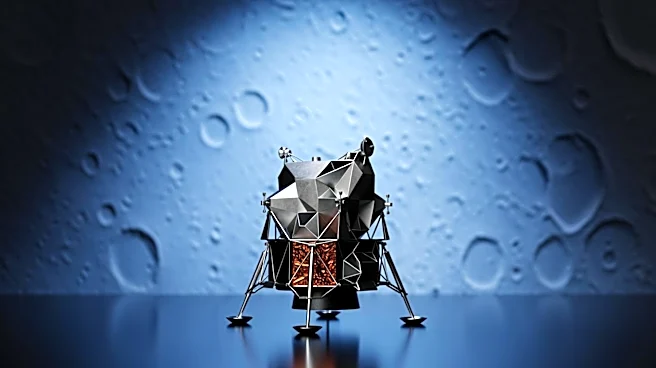




Ranger 4 was a sophisticated piece of technology designed to advance the United States' lunar exploration efforts. Launched in 1962, it was part of the Ranger program, which aimed to develop and test spacecraft capable of interplanetary missions. This article delves into the technical aspects of Ranger 4, highlighting its design, instruments, and the challenges it faced.
Design and Structure
Ranger 4 was a Block II Ranger spacecraft, similar in design to its predecessor,
Ranger 3. The spacecraft weighed 331 kg (730 lb) and stood 3.1 meters (10 feet) tall. Its structure included a lunar capsule covered with a balsawood impact-limiter, a mono-propellant mid-course motor, a powerful retrorocket, and a hexagonal base. The base was adorned with a large high-gain dish antenna, essential for communication with Earth.
The spacecraft's power was generated by 8,680 solar cells housed in two wing-like solar panels, which were designed to deploy early in the flight. These solar panels charged an 11.5 kg (25 lb) battery, providing the necessary energy for the spacecraft's operations. Control of the spacecraft was managed by a solid-state computer and sequencer, along with an Earth-controlled command system. Attitude control was achieved through a combination of Sun and Earth sensors, gyroscopes, and pitch and roll jets.
Scientific Instruments and Objectives
Ranger 4 was equipped with a suite of scientific instruments designed to gather data about the Moon. These included a vidicon television camera, a gamma-ray spectrometer, a radar altimeter, and a seismometer. The television camera was intended to capture images of the lunar surface, while the gamma-ray spectrometer was mounted on a boom to collect data on the Moon's composition.
The radar altimeter had dual purposes: it was used for reflectivity studies and was also designed to initiate capsule separation and ignite the retro-rocket. The seismometer, encased in the lunar capsule, was meant to be rough-landed on the Moon's surface to study seismic activity. Unfortunately, due to a computer failure, these instruments were unable to fulfill their intended functions.
Challenges and Impact
The mission faced significant challenges, primarily due to the failure of the onboard computer. This malfunction prevented the deployment of the solar panels and high-gain antenna, leaving the spacecraft without power and unresponsive to commands. Despite these setbacks, Ranger 4 made history as the first U.S. spacecraft to reach another celestial body and the first to impact the far side of the Moon.
Ranger 4's technical design and the challenges it encountered provided valuable lessons for future missions. The insights gained from this mission contributed to the development of more reliable and successful spacecraft, paving the way for continued exploration of the Moon and beyond.