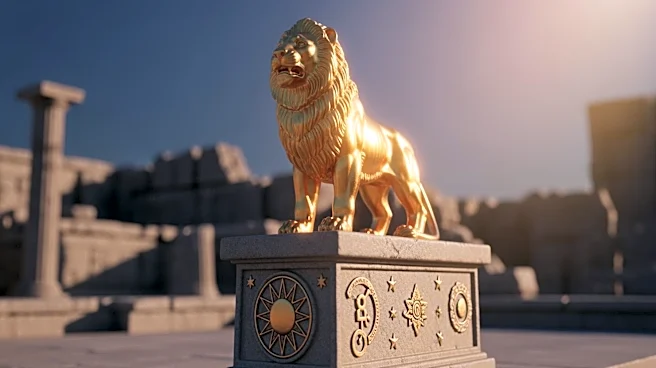







The constellation Leo has been a source of fascination and inspiration throughout history. Known for its association with the lion, Leo has deep roots in mythology and has been recognized by various cultures for millennia. This article explores the mythological stories and historical significance of Leo, highlighting its enduring legacy in human culture.
Mythological Origins
Leo's mythological origins are deeply rooted in Greek mythology, where it is identified as the
Nemean Lion. According to legend, the Nemean Lion was a monstrous beast that terrorized the region of Nemea. Its hide was impervious to weapons, making it a formidable adversary. Heracles, known to the Romans as Hercules, was tasked with defeating the lion as the first of his twelve labors. Using his immense strength, Heracles strangled the lion, ultimately triumphing over the beast.
The story of the Nemean Lion is just one of many mythological associations with Leo. The constellation has also been linked to the god Bacchus, known for his connection to lions. Roman poet Ovid referred to Leo as Herculeus Leo and Violentus Leo, emphasizing its fierce nature. These mythological connections have contributed to Leo's reputation as a symbol of strength and courage.
Historical Recognition
Leo's recognition as a constellation dates back to ancient times. Archaeological evidence suggests that the Mesopotamians had a similar constellation as early as 4000 BCE. In Babylonian astronomy, Leo was known as UR.GU.LA, the "Great Lion," and its brightest star, Regulus, was called "the star that stands at the Lion's breast." This star held regal associations, often referred to as the King Star.
The constellation's significance extended to other cultures as well. The Persians called it Ser or Shir, the Turks referred to it as Artan, and the Indians named it Simha, all meaning "lion." These diverse cultural connections highlight Leo's widespread recognition and importance throughout history.
Leo's Legacy
Today, Leo remains one of the most recognizable constellations in the night sky. Its distinctive shape and bright stars make it a favorite among stargazers. The constellation's rich history and mythological associations continue to captivate the imagination, serving as a reminder of humanity's enduring fascination with the stars.
Leo's legacy is not only found in mythology and history but also in modern astronomy. It is one of the 88 modern constellations recognized by astronomers and is home to several notable stars and deep-sky objects. As such, Leo continues to be a symbol of strength and a testament to the enduring power of myth and history.