/images/ppid_a911dc6a-image-177919003056082518.webp)

/images/ppid_a911dc6a-image-177898356520260022.webp)
/images/ppid_a911dc6a-image-177891702439440460.webp)

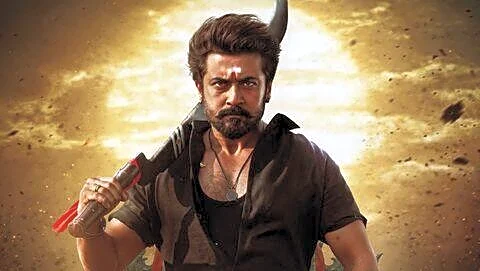
Cinema has always been a courtroom – of sorts – delivering cinematic justices and making right narrative wrongs, Films have always imagined – more than the judiciary delivering verdicts – another force stepping in – gods, spirits, fate, ancestral memory and mythic rage. That there is an extraordinary response around Karuppu, RJ Balaji’s devotional courtroom drama starring Suriya – despite all the hullabaloo pre-release, is the latest reminder that audiences continue to seek something beyond mortal justice. Reviews have already highlighted that the film is a blend of mythology and systemic critique with the guardian deity Karuppusamy entering a corrupt legal world to restore balance. One can say that the appeal of Karrupu is not merely its mass
moments or devotional imagery, but rather, it lies in a deeply familiar emotional promise as well. When man-made institutions fail, a higher power answers. And that promise has shaped Indian cinema for decades.
In RJ Balaji’s Karuppu, which released on May 15, Suriya plays a lawyer Sarvanan, who is actually a folk deity Karuppusamy. He enters a judicial system that is exploitative and broken and becomes a saviour for the ordinary people who are trapped in an endless loop of legal and bureaucratic red tape-ism. Interestingly, the premise itself taps into a universal anxiety where justice delayed automatically become justice denied and audiences instinctively search for something beyond the mortal. And this is where cinema often turns to divinity.Cinema of the South, in particular, has a long relationship with folk deities and guardians. Karuppasamy is not a distant celestial figure. Rather he is a protector rooted in the land, memory and collective conscience of the local people. Unlike polished mythical gods, much like other folk deities, he is often fierce, immediate and deeply connected to every day injustice, representing a moral correction. That also makes Karuppu part of a larger cinematic tradition. Take for instance the 2021 film Karnan. Directed by Mari Selvaraj, while the Dhanush the film never explicitly invokes divine intervention, yet it is saturated with spiritual symbolism. Karnan’s rebellion is framed through folklore, omens and ritual memory. The broken sword of divinity, the village deity - all become signs of collective anger. Ultimately, justice in Karnan does not arrive through courts or state institutions; it emerges out of resistance and ancestral force.Similarly, the 2022 Rishab Shetty film Kantara sees the turning of the idea of divine justice into a mainstream phenomenon. The film’s climax, where the protagonist becomes possessed by Panjurli Daiva, resonated far beyond Karnataka because it offered an emotional release modern systems rarely provide. Where bureaucracy failed; divinity acts. The extraordinary success of Kantara, (which also spawned a sequel), showed that audiences were willing to embrace folklore – not merely as nostalgia – but as moral truth as well. Similarly, RJ Balaji’s 2020 Mookuthi Amman, sees a goddess (played by Nayanthara) entering contemporary society to challenge corruption and exploitation. The film uses both humour and devotion to highlight the same question – what happens when systems stop serving people?In fact, even the 2024 Teja Sajja starrer Hanu-Man sees the blending of Indian mythology with the superhero genre. The film centres on a small-time thief who stumbles upon a magical gem granting him the power of Lord Hanuman. The climax features immense divine intervention and an epic showdown as the protagonist struggles to channel the divine power to protect his village from corrupt forces. Indian cinema repeatedly returns to this conflict because it mirrors the lived reality of the audience. Legal processes in the country are slow. Social hierarchies persists and the institutions of justice feel distant. Cinema, thus, creates an alternative universe where justice is immediate.And that is not all, even outside the purview of devotional films, divine justice exists in disguised forms. Anniyan by S. Shankar is essentially divine justice wrapped in psychological thriller language. Ambi becomes judge, jury and executioner, inspired by Garuda Purana punishments. The state fails; myth intervenes. Similarly, in Aparichit and similar vigilante narratives, the audience is invited into a fantasy where moral order is restored instantly. The attraction is obvious: viewers experience catharsis unavailable in reality.To understand why Indian cinema and as an extension the Indian audience keeps on going back to the stories of divine justice. Indian storytelling traditions – be it the Mahabharata or other folk ballads, rarely separates morality from cosmic order. Dharma is not merely legal correctness, it is balance and when balance breaks, divine forces restore it. Cinema, it seems inherited this worldview. This is perhaps why audiences respond powerfully to films like this. Even if they are grounded in realism, might not even feature gods their emotional structure resembles divine justice narratives – like in the case of Jai Bhim. Legal fights themselves become sacred because they restore dignity to the powerless. However, what makes Suriya’s Karuppa interesting is that it openly embraces the supernatural at a time when Indian cinema has become increasingly street-level and politically conscious. The film mixes courtroom drama with devotional fantasy, allowing divine intervention to enter a modern institutional setting. And perhaps that fusion reflects audience psychology today. Audience discussions online have already interpreted Karuppu less as grounded realism and more as folklore-driven “god mode” cinema, suggesting viewers accepted its exaggerated mythic tone as intentional. And maybe that is why the film is seeing massive success – it is not asking us to believe in miracles literally, but is asking us to believe that morality still matters.From Karnan and Kantara to Mookuthi Amman, Anniyan and now Karuppu, Indian cinema repeatedly returns to divine justice because audiences continue to crave moral certainty. The audience craves for cinema that feels complete.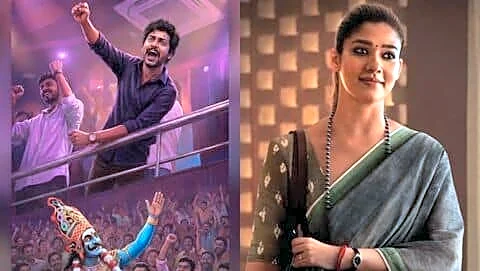

/images/ppid_a911dc6a-image-177912702614774217.webp)

/images/ppid_a911dc6a-image-177903959482212357.webp)
/images/ppid_a911dc6a-image-177909205801877688.webp)


/images/ppid_a911dc6a-image-17790395321965559.webp)
/images/ppid_a911dc6a-image-177893107432699247.webp)