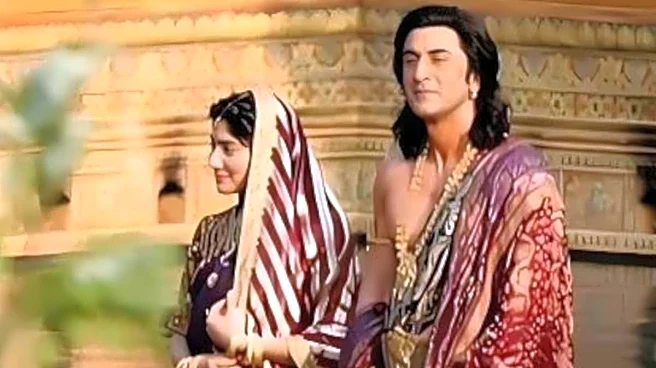
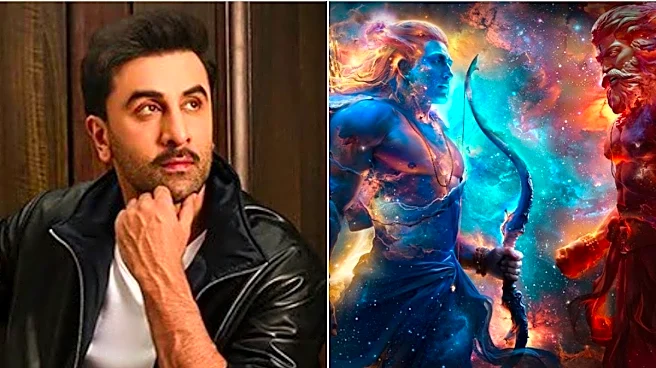
The first teaser of Namit Malhotra’s Ramayana featuring Ranbir Kapoor as Lord Rama has finally hit social media. The Nitesh Tiwari directorial, which will also see Sai Pallavi as Sita and Yash as Rama’s primary antagonist Ravana – the King of Sri Lanka, is intriguing with DNEG's visual effects recreating the majestic and mythical world of Lord Rama. The film, which will also see Sunny Deol play Hanuman is slated for a Diwali 2026 release. However, this is not the first time that Lord Rama has entered mainstream cinema. One of the most talked-about divinities in contemporary times, few epics in the world literature has enjoyed so much of cinematic afterlife as the Ramayana. Primarily attributed to Sage Valmiki, the tale of Rama, Sita and Ravana has managed
to transcend language, geography and medium – repeatedly finding expressions in films, televisions, animation and experimental retellings. So the short answer to how many times has Ramayana been turned into cinema would perhaps be – many. On a larger level, the multiple Ramayana adaptations reveal a vast growing world that reflect shifting cultural, political, and artistic sensibilities.
Ramayana’s Foray Into Cinema
Ramayana entered into the world of cinema as soon as India embraced filmmaking. The
1917 Lanka Dahan, by Dadasaheb Phalke, a silent production, dramatised Hanuman’s journey to Lanka and set the precedent for mythological storytelling on screen. Then, in
1931 Chandrasena, a silent film by V Shantaram and Keshavrao Dhaiber showcased an episode from Ramayana where Ahiravan's wife Chiandrasana helped Hanuman rescue Rama and Lakshamana from Patala. Close behind came the
1940 Telugu film Bhookailas, but this was more to do with Ravana than Maryada Purushottam Rama.Through the 1920s and 1930s, multiple silent and early talkie films revisited short episodes form the epic, focusing on specific characters and arcs rather than the entire narrative.
Ramayana A Staple In Cinema
However, by the mid-20th century, Ramayana-based films had become a staple across India, with film industry clamouring to bring the epic to life. Films like the
1942 Bharat Milap (Ramayana from the point of view of Bharat) and
Vijay Bhatt's Ram Rajya (1943) gained immense popularity, with the latter even reportedly watched by Mahatma Gandhi. Vijay Bhatt would go on to make the
1954 Ramayan where Prem Adib and Shobhhana Samarth returned as
Rama and Sita after working in Bharat Milap. The film focused on their twin sons Luv and Kusha. Meanwhile, regional cinemas too, be it Tamil, Telugu, Bengali, Kannada, and Malayalam - produced their own interpretations.
Ramayana In Later Years
Throughout the 1960s and 1970s filmmakers began exploring not just devotion, but character psychology and moral ambiguity in Ramayana as well. The
1967 Ram Rajya (once again by Vijay Bhatt) combined Valmiki's Ramayana, with Tulsidas' Ramcharitmanas and Bhavbhuti's play Uttar Ramcharit, while the
1976 Tamil Dasavatharam showcased the avatars of Vishnu, with a segment dedicated to Lord Rama as well. Later, animated adaptations also started appearing, culminating decades later in
Ramayana: The Legend of Prince Rama (1993), a landmark Indo-Japanese collaboration that introduced the epic to global audiences. Of these the
2023 Adipurush - which retells Ramayana with Prabhas, Saif Ali Khan, Kriti Sanon in lead roles has perhaps been the most criticised for its screenplay, dialogues and visuals.
If short, there are roughly between 50 to 70 films that are direct cinematic adaptations in India alone. However, the films that retell the epic partially or with other angles could easily cross 200. For instance, numerous films centre on Hanuman, Ravana, Sita, or even Bharath, offering alternate perspectives that challenge traditional telling.
Ramayana In Television And Modern Films
Television, though not strictly “cinema,” has perhaps had the most influence on local culture and society by shaping the modern visual imagination of the Ramayana.
Ramanand Sagar’s Ramayan with Arun Govil as the titular hero, remains perhaps the most iconic screen adaptation, drawing unprecedented viewership and becoming a cultural phenomenon. In more recent times, contemporary filmmakers are reimagining the epic through new lenses – be it feminist, political, fantastical or even speculative. The
2024 Teja Sajja starrer Hanu-Man is perhaps one of the best example of cinema making the epic feel relevant for the young generation. While
Namit Malhotra’s upcoming Ramayana – by its first look – appears to have largely remained true to the epic,
SS Rajamouli's Varanasi, speculatively, is also centred around the epic, though in a modern, contemporary setting. The film which will have Mahesh Babu, Priyanka Chopra and Prithviraj Sukumaran in lead roles is scheduled for a April 2, 2027 theatrical release.
Ramayana Reborn In Cinema - Silent Films To Singham Again
Ramayana – the epic – itself exists in hundreds of versions – be it oral, written and performative. As an extension, films made on it are not just retellings but reinterpretations as well. The Ramayana appears in cinema, often in disguised forms as well. Cinema sometimes borrow its narrative structure – be it the exile, the abduction, the battle between good and evil (
RRR, Singham Again, Rudraksh) without explicitly naming the characters.
Ramayana has been continuously reborn through cinema – from early silent films to modern spectacles – devotional retellings to subversive reinterpretations – proving to be a testament to its enduring relevance across geographies and generations.
/images/ppid_a911dc6a-image-177511606909647715.webp)


/images/ppid_a911dc6a-image-177489202903713065.webp)


/images/ppid_a911dc6a-image-177511259868846192.webp)
/images/ppid_a911dc6a-image-177510553442843188.webp)

/images/ppid_a911dc6a-image-177502853410311068.webp)
/images/ppid_a911dc6a-image-177503205853987124.webp)

/images/ppid_a911dc6a-image-177510903137097880.webp)