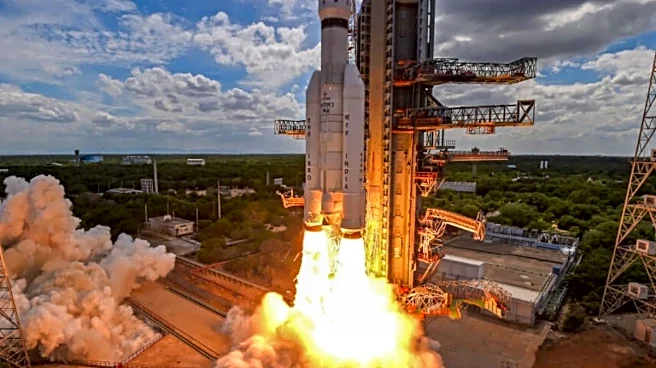
Offering
space travel services to the Moon is still a dream for many companies. The big tech companies are interested in purchasing land there and taking people on space voyages. It is expensive, with rockers carrying huge amounts of fuel to complete the journey. Every kilogram of propellant increases the launch costs and reduces the space available for instruments. Now, a team of researchers has found a surprising route to the Moon that is likely to make future lunar missions cheaper.
A Different Way To Study Space Travel
This discovery has come from a new study that was published in April 2026 in the journal Astrodynamics. Experts from the University of São Paulo and the University of Coimbra have examined the millions of possible Earth-to-Moon paths using advanced computer simulations. To carry out this research, the team of experts used a method known as the ‘theory of functional connections', which can help reduce the computing power required for complex
orbital calculations. The researchers studied around 30 million possible trajectories and analysed nearly 280,000 of them for the final paper. Rather than focusing on the shortest route between the Moon and Earth, experts searched for less obvious paths that might save fuel. As per this research, the approach may help the space agencies to design their missions accordingly. This study has explored an unnoticed system of gravitational pathways in space called the Interplanetary Transportation Network. These natural corridors could be created by the combined gravitational pull of planets and the moon and may guide the spacecraft using less energy. Additionally, this newly identified path can save about 58.8 metres per second of fuel compared to the best route previously known. Although that number might be small, even minor fuel savings can significantly reduce the mission costs in space travel.
The findings may also influence future journeys beyond the
Moon. By understanding and using hidden gravitational pathways more effectively, scientists could eventually create cheaper and more sustainable routes across the solar system.
/images/ppid_a911dc6a-image-17794525332277846.webp)





/images/ppid_59c68470-image-17795000274179439.webp)

/images/ppid_a911dc6a-image-177949451842190328.webp)
/images/ppid_a911dc6a-image-177959952809035911.webp)



/images/ppid_59c68470-image-177941514034311804.webp)