After
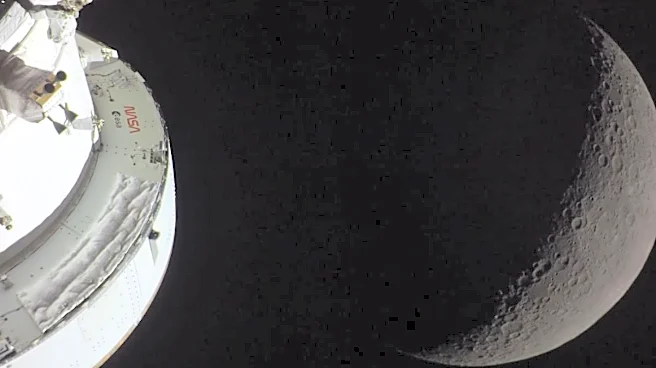
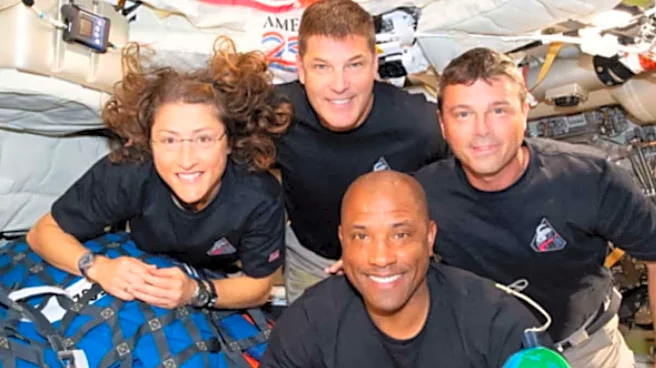
ten days in space and a journey that took them farther from Earth than any human beings, the four astronauts are nearly home. Artemis II lifted off from Kennedy Space Center in Florida on April 1, carrying commander Reid Wiseman, Victor Glover, Christina Koch, and Jeremy Hansen on a historic loop around the moon. After spending the first day in Earth's orbit to confirm their spacecraft was functioning properly, the crew became the first humans since 1972 to venture toward the moon.
The mission broke records along the way. As the crew swung around the lunar far side, they passed a point 252,756 miles from Earth, roughly 4,100 miles beyond the distance record previously set by the Apollo 13 crew in 1970.
What They Saw Up There
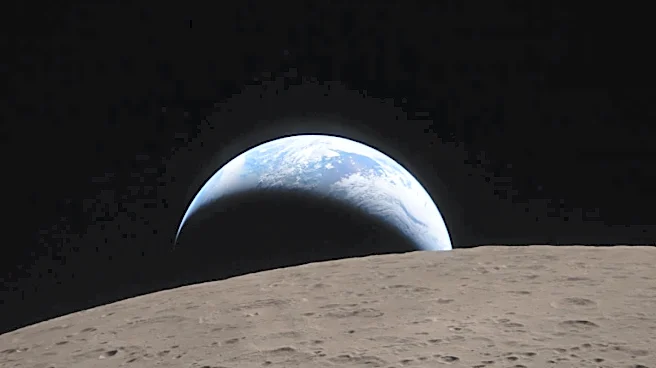
Parts of the moon's far side that had never been seen by human eyes came into view during the mission, as those areas were in shadow during the Apollo era. The crew also witnessed a 53-minute solar eclipse, a sight that clearly left an impression on both the astronauts and those watching from Earth.Beyond the impressive visuals, the mission's core objective was a technical one: to demonstrate the Orion spacecraft's capacity to safely transport humans to the moon and return them, with its most vital systems, such as life support and propulsion, in reliable working order. However, it wasn't without its difficulties.The journey encountered some bumps along the way. The crew faced communication issues and, less than ideally, a malfunctioning toilet, underscoring the fact that space travel requires both advanced engineering and, quite simply, a good understanding of plumbing. Neither issue derailed the mission.
What Splashdown Looks Like
If everything goes to plan Friday evening, the sequence of events will unfold quickly. At 7:33 p.m. Eastern time, the crew capsule is set to separate from the service module, the section housing the main power, propulsion, and communications systems. Four minutes after that, the capsule's thrusters will fire to lock it onto the correct re-entry path.By 7:53 p.m., the capsule will hit the upper atmosphere at close to 24,000 miles per hour. Air friction will scrub off most of that speed, and parachutes will handle the rest. Splashdown in the Pacific Ocean, west of San Diego, is targeted for 8:07 p.m. Eastern.
How to Watch
NASA will carry the return live starting at 6:30 p.m. Eastern time. The stream will be available on the agency's YouTube channel, its X account, its official website, and through its smart TV apps.
The One Concern That Won't Go Away
Re-entry has always been among the most dangerous moments in human spaceflight, second only to launch. According to a report from New York Times, for Artemis II, there is an added layer of concern that NASA itself has acknowledged: known flaws in the Orion capsule's heat shield, which is responsible for protecting the crew as the spacecraft tears back through the atmosphere.NASA has said its analysis shows the shield will still do its job despite those imperfections, and the agency adjusted the return trajectory to reduce the risks those flaws could pose. Even so, a number of former NASA astronauts and engineers with backgrounds in thermal protection have been vocal in their belief that the mission should not have launched at all given those unresolved issues. For now, the world watches and waits.
/images/ppid_a911dc6a-image-177586152919559056.webp)

/images/ppid_a911dc6a-image-177579852693968118.webp)
/images/ppid_a911dc6a-image-17757915260509984.webp)


/images/ppid_59c68470-image-177587010743863218.webp)

/images/ppid_a911dc6a-image-177586852085130574.webp)


/images/ppid_a911dc6a-image-177588252793652807.webp)