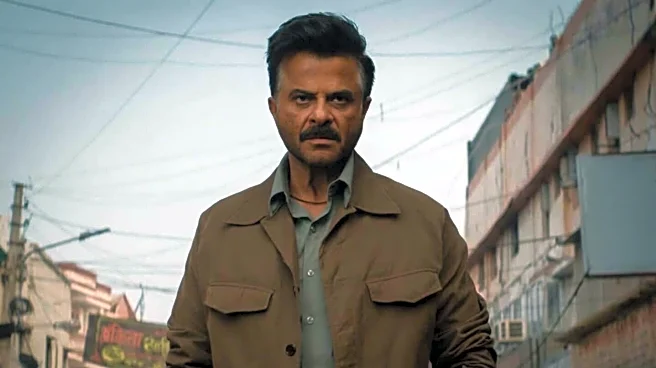
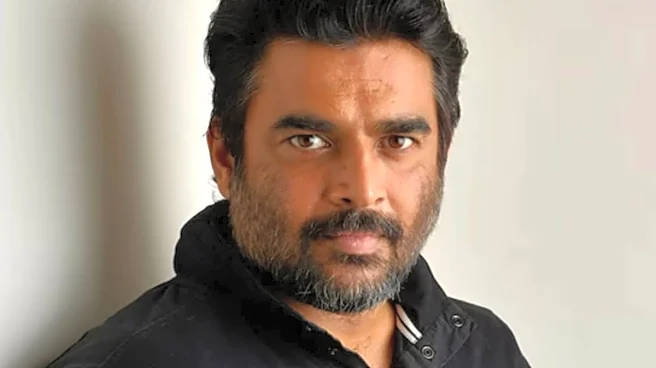
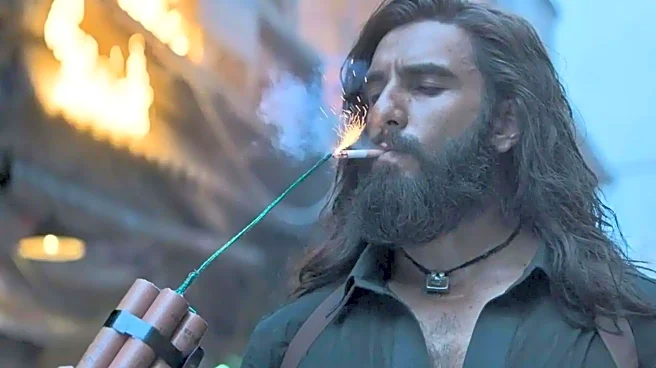
Ranveer Singh's Dhurandhar is racing towards Rs 1000 crore globally. The Aditya Dhar directorial is a gritty, gory, emotional film, tainted in shades of graphic cerulean that has left many in the audience - including me - at the edge of the seat, in a cringe-induced cinematic coma. Do we love it? Do we hate it? Do we even understand what is happening? Starring Singh along with a swoon-worthy ensemble cast of Akshaye Khana, Sanjat Dutt, Arjun Rampal, R Madhavan and Sara Arjun, among others, the film has, as shown by the numbers (and numbers do not lie) resonated with the larger audience in a way few films have in the recent past. In an era where spectacle trumps substance, Dhurandhar has done something few big-ticket releases even attempt at –
it repeatedly breaks the fourth wall. The filmmaker does not do it through direct-to-video eye contact, winks or meta humour. Instead Dhar opted to insert fragments of India’s lived reality directly into the narrative.Real-life footage from the 2001 Indian Parliament Attack, news clips, grainy audio recordings from the gory 26/11 attacks and recognisable public moments puncture the film’s fictional universe, reducing the distance between the screen and the spectator. The film does not merely entertain, but unsettles, implicates and perhaps deeply resonate with the average Indian viewer.
Dhurandhar Is Fiction Interrupted by Reality
At its centre,
Dhurandhar does not shy away from being a film about power. While the narrative unfolds through fictive characters and dramatized events, Dhar repeatedly interrupts this flow with real-world inserts and references that feel too personal. Arguably, these intrusions and insertions are not decorative in nature. Instead the act as reminders that the story unfolding onscreen is not an abstract tale on morality, but one rooted in recognisable socio-political rhythms. For
the average Indian audience accustomed to consuming reality through television, these moments are disturbingly familiar. The film does not allow the audience to escape, but it insists that the story belongs to their habitable world.
Dhurandhar And The Power of Recognisability
One of the main reasons,
Dhurandhar resonates do strongly is in is use of recognisable textures of Indian public life. Whatever is enacted mirror the way Indians have been encountering reality every day in terms of their relationship with their neighbouring nation.
Also Read: Dhurandhar: When Sound Becomes Strategy - How Aditya Dhar Weaponises Music As Narrative Power In Ranveer Singh Film Thus fictive enactments like Ajmal Kasab being handed an AK47, which he would go on to use and gun down multiple innocent citizens in real life, send a chill down one’s spine. Even when Major Iqbal is instructing Kasab and his fellow terrorists on how to gun down innocent civilians is chill worthy. These cues trigger emotional recall, allowing the audiences to project their own experiences onto the film.
Dhurandhar, thus becomes less about a singular protagonist and more about a shared national consciousness.
Ranveer Singh Is A Conduit
Ranveer Singh, in one of his more layered and restrained performance in recent years plays a crucial role in enabling this resonance. He does not insulate the audience from reality through star charisma, but functions as a conduit through which reality flows. His may be a fictive character, but it frequently exists at the intersection of personal ambition and public conscience. Moments when his moral certainties begin to fracture form some of the most compelling moments in the film.
How Dhurandhar Breaks the Fourth Wall Without Addressing the Camera
Unlike the conventional sense of breaking the fourth wall,
Dhurandhar never has its characters speak directly to the camera. Instead the wall is shattered structurally by inserting reality into fiction.
The film positions the audience as witnesses and sometimes as re-livers rather than passive observers. In ways, this mirrors the Indian audience’s lived experience of politics and power in the country. The film’s refusal to maintain narrative purity – by dotting the plot plot with real sinister and gore - mirrors a society where personal and political spheres are inextricably linked.
Dhurandhar’s Moral Ambiguity
Dhurandhar is morally ambiguous. While we may cheer our hypermasculine hero, the film lets reality speak for itself. There is no explanatory voiceovers or moral signposting – there simply is. They coexist with the fictional narrative, creating tension, rather than resolution. This ambiguity adds a delicious flavour to the film – some may see it as a critique of authoritarianism, some a study of emotion and others a mirror to societal complicity.
The film respects the intelligence of its audience, in whichever direction thoughts may stray - a rare gesture in mainstream cinema.
Also Read: Ranveer Singh's Dhurandhar, Shahid Kapoor's Kabir Singh, Ranbir Kapoor's Animal ALL Highest Grossers: Does Hypermasculinity In Bollywood Really Sell?
Dhurandhar’s Collective Memory And Emotional Currency
The average Indian viewer has a vast archive of collective memory out there in public domain that has been shared by decades of geopolitical upheavals, economic shifts and national debates.
Dhurandhar taps into this with surgical precision, evoking entire eras and emotions. And this emotional shorthand allows the film to achieve depth without exposition.
Dhurandhar trusts the audience to feel every moment without going into detailed explanations. And that trust has been rewarded. There has been a resounding engagement that is continuing beyond the proscenium, spilling into conversations and debates long after the credits roll. In many ways Dhar has successfully turned his cinema into a living document by positioning fictional narrative within a historical milieu. By breaking the fourth wall through reality rather than rhetoric,
Dhurandhar achieves something rare - it makes the average Indian viewer feel seen. The film willingly confronts audiences with fragments from their own world, and in doing so, evolves from a political thriller and spy film to a shared experience that blurs the line between cinema and life.
/images/ppid_a911dc6a-image-176606152741972022.webp)



/images/ppid_a911dc6a-image-177095176389429444.webp)
/images/ppid_a911dc6a-image-177083903258342419.webp)



/images/ppid_a911dc6a-image-177073406474645209.webp)
/images/ppid_a911dc6a-image-177074817751365859.webp)
/images/ppid_a911dc6a-image-177073762995729463.webp)