NASA
has announced fresh details about its Artemis III mission, which is scheduled for next year. This mission plays a crucial role in preparing humans to return to the Moon. The American space agency revealed the four astronauts chosen for the mission on Tuesday and explained how the test flight will work.This upcoming mission is set to launch from NASA’s Kennedy Space Center in Florida, which involves three separate rocket launches and test docking operations between the Orion spacecraft and lunar landers that are developed by Blue Origin and SpaceX. The goal is to demonstrate technologies needed for future crewed Moon landings, starting with Artemis IV in 2028.
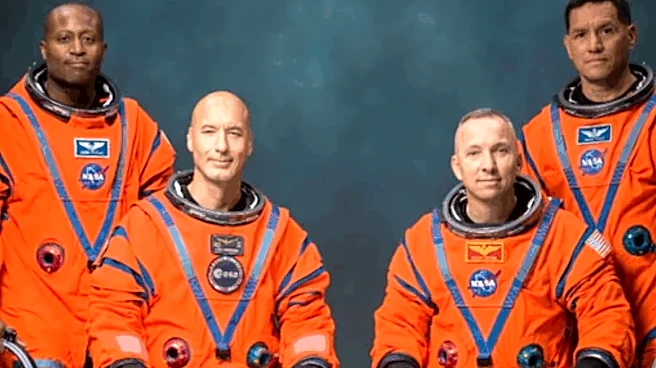
Who Are The Four Astronauts Selected For Artemis III?
The space agency revealed that astronaut Randy Bresnik will lead the mission, while European Space Agency (ESA) astronaut Luca Parmitano is set to serve as the pilot. Moreover, NASA’s other astronauts Andre Douglas and Frank Rubio will be the mission specialists. NASA has also named Bob Hines as the backup crew member. Notably, Parmitano became the first ESA astronaut chosen for an Artemis mission.
What Is The Mission About?
Artemis III will test the critical systems in low Earth orbit rather than heading directly toward the Moon. After launching aboard
NASA’s Space Launch System (SLS) rocket, the Orion spacecraft will carry the crew into orbit around Earth. Orion will further perform docking operations with test versions of lunar landers being developed by SpaceX and Blue Origin. The space agency mentions that intense tests will verify spacecraft interfaces, software, propulsion systems, communications equipment and other technologies which are needed for future moon exploration programmes.This mission is likely to last around 15 days, although the exact duration may vary depending on how the operations unfold in space.
Building Toward Future Moon Landings
NASA has described the Artemis III as one of the most crucial and challenging human spaceflight missions ever attempted because it will need multiple heavy-lift
rocket launches and critical docking operations in orbit.This mission will pave the way for Artemis IV, which is planned to send astronauts to the Moon's south polar region in 2028. Beyond lunar exploration, the technologies and operation experience gained from Artemis III may help support future missions deeper into space. This also includes sending humans to Mars.
/images/ppid_a911dc6a-image-178106603508715051.webp)

/images/ppid_59c68470-image-17808950668275690.webp)
/images/ppid_59c68470-image-178089503142770047.webp)



/images/ppid_a911dc6a-image-178105907101222051.webp)

/images/ppid_59c68470-image-178091507007837111.webp)

/images/ppid_a911dc6a-image-178090853674861207.webp)